Filipino vs Indonesian vs Myanmar Maid Singapore: Honest 2026 Comparison
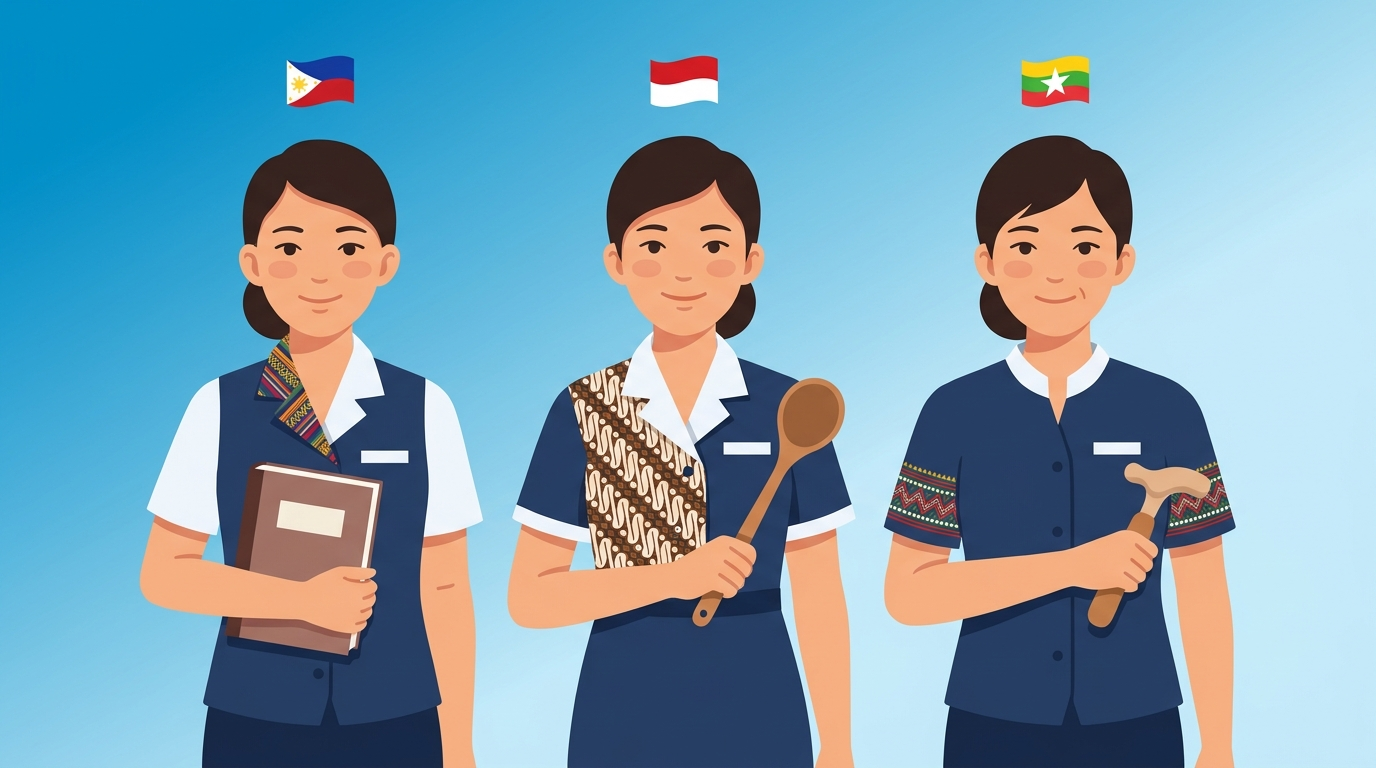
TL;DR: There is no single best maid nationality in Singapore. A Filipino maid tends to lead on English, an Indonesian maid on Asian cooking and Malay-speaking eldercare, and a Myanmar maid on calm, patient care. The biggest 2026 change: Filipino helpers now need a minimum salary of SGD 650 for contracts from 21 October 2025. Singapore itself sets no minimum wage, so match the helper to your household, not the stereotype.
If you are comparing a Filipino, Indonesian, or Myanmar maid in Singapore, you will find the same question on every parenting forum: filipino vs indonesian maid, which one should I hire? The replies are full of generalisations that have not aged well. This guide walks through what actually differs between the three nationalities in 2026, using official rules where they exist and honest framing where they do not. Rules were re-checked on 22 September 2026.
The Reality: There Is No 'Best' Nationality, Only Best Fit for Your Household
Every helper is an individual. A 32-year-old Indonesian helper with five years of newborn care in Singapore is not interchangeable with a first-contract Indonesian helper. A Filipino helper with a nursing diploma is not the same as one whose strongest skill is elderly companionship.
Nationality is a useful starting filter, not a verdict. It hints at likely language background, cooking traditions and the paperwork route. It tells you nothing about work ethic, kindness, or competence.
The question is not "which nationality is best?" It is "which background tends to match the daily reality of my home?"
What Is the Same for Every Nationality
MOM's rules do not change with the passport. For every new helper:
- She must be aged 23 to below 50 at the Work Permit application, with at least 8 years of formal education and a recognised certificate.
- Indonesia, Myanmar and the Philippines are all on MOM's list of approved source countries.
- You pay the same levy ($300 a month for a first helper, $60 if you qualify for the concession), the same $5,000 security bond and the same minimum insurance of $60,000 medical and $60,000 personal accident.
- She is entitled to one rest day a week, with at least one a month that cannot be compensated away.

Filipino Helpers in Singapore: Strengths, Salary, Cultural Notes
Salary: Under DMW Advisory No. 25, Series of 2025, the minimum monthly salary for Filipino domestic workers in Singapore is SGD 650 (USD 500), up from USD 400. It applies to new contracts and renewals processed from 21 October 2025.
Language: English is widely used in the Philippines, so many Filipino helpers communicate fluently, a real advantage for paediatrician calls, school chats, or employers who do not speak Bahasa or Mandarin.
Childcare: Strong reputation, especially where English homework supervision matters.
Cooking: Often Western-leaning. Asian home cuisine (Peranakan, Chinese soups, Indian curries) may need training.
Paperwork: The most steps of the three. The Philippines bans direct hiring of domestic workers, so hiring goes through a Singapore agency and a DMW-licensed Philippine agency. New contracts need a mandatory "Know Your Employer" video call with you, contract verification at the Migrant Workers Office in Singapore, pre-departure training, and an Overseas Employment Certificate. No placement fee may be charged to the helper (MWO Singapore).
Cultural notes: Many Filipino helpers are Catholic, and Sunday rest days are common. See current Filipino helper bio-data.
Indonesian Helpers in Singapore: Strengths, Salary, Cultural Notes
Salary: Singapore sets no minimum wage for domestic workers, and we did not find an Indonesian government salary floor for Singapore placements on an official source. Salary is agreed between you and the helper and declared to MOM.
Language: English ability varies. Bahasa Indonesia is close to Bahasa Melayu, which helps with Malay-speaking elderly.
Cooking: One of the strongest reasons families choose Indonesian helpers. Asian home cooking often comes naturally, including halal-compatible meals.
Eldercare: Patient and culturally comfortable in multi-generation Asian households.
Paperwork: Indonesia's Law No. 18 of 2017 routes placements through licensed placement companies (P3MI) and bars individuals from placing workers, so your Singapore agency works with a P3MI partner. Oversight sits with KP2MI, the ministry that replaced BP2MI in 2024.
Cultural notes: Many Indonesian helpers are Muslim. Discuss Ramadan fasting and prayer times openly at the interview; most employers find this easy to plan around. Browse Indonesian helper profiles.
Myanmar Helpers in Singapore: Strengths, Salary, Cultural Notes
Salary: As with Indonesian helpers, there is no Singapore minimum wage; salary is agreed with the helper and declared to MOM.
Language: English ability varies widely. Test it in a video interview rather than assuming.
Temperament: Often described by employers as calm, soft-spoken and patient, qualities valued in eldercare and dementia support. This is a communication-style observation, not a claim about "obedience".
Eldercare: A strong choice for households with elderly parents, where patience and an unhurried pace matter more than English fluency. See our eldercare helper service.
Cooking: Myanmar home cooking shares ingredients with both Chinese and Indian cuisines, which can make adapting to Singapore menus easier.
Paperwork: Exit requirements are set by Myanmar authorities. Work with a licensed Singapore agency that places Myanmar helpers and ask it to explain the current steps. View Myanmar helper bio-data.
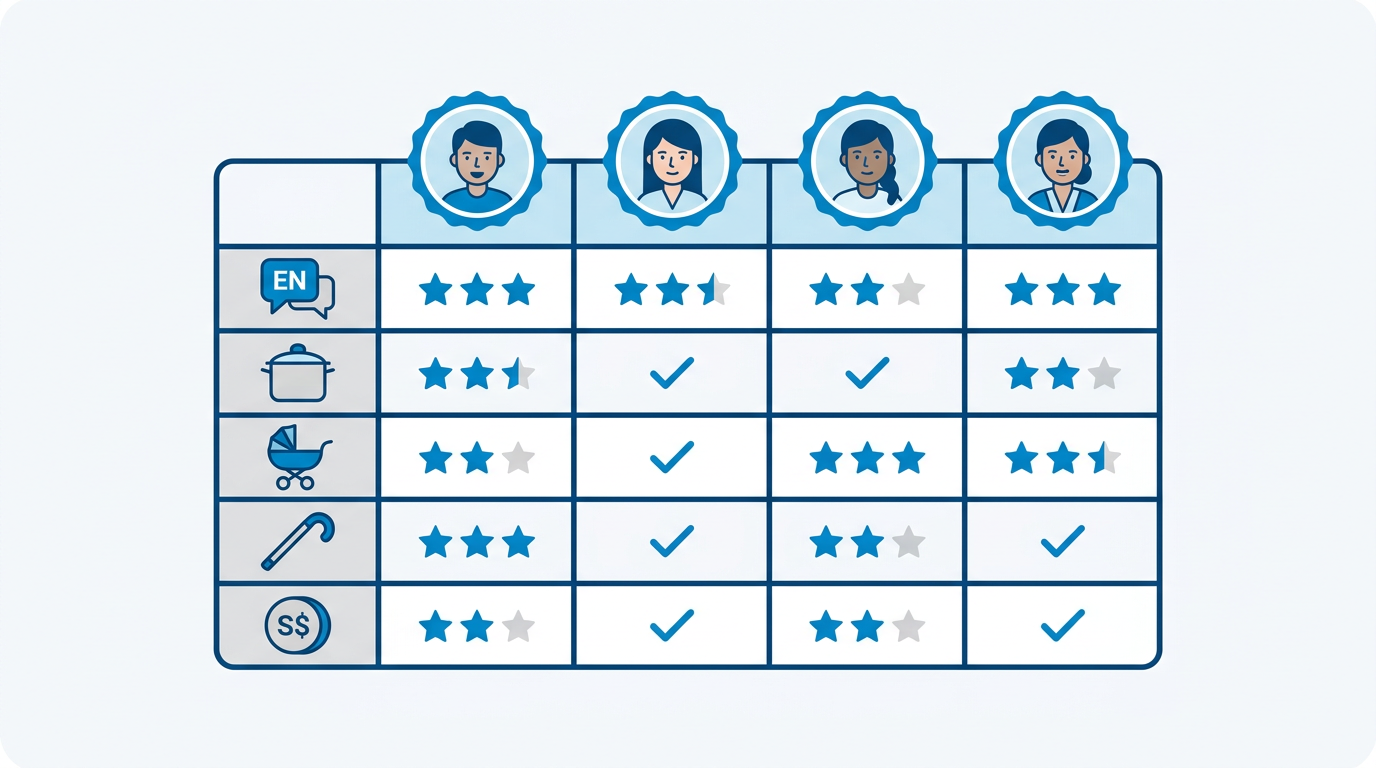
Honest Comparison Matrix: English, Cooking, Childcare, Eldercare, Salary Rules, Paperwork
The skill rows show average tendencies; individual helpers vary widely. The salary and paperwork rows are official rules.
| Factor | Filipino | Indonesian | Myanmar |
|---|---|---|---|
| Salary floor (2026) | SGD 650, set by the Philippine DMW | No Singapore minimum; agreed with helper | No Singapore minimum; agreed with helper |
| English fluency | Strong | Varies | Varies |
| Asian home cooking | Trainable | Strong | Adaptable |
| Childcare (newborn) | Strong | Good | Good |
| Eldercare | Good | Strong | Strong |
| Home-country hiring route | Licensed agency on both sides, KYE video call, MWO contract verification, OEC | Licensed P3MI partnered with a Singapore agency | Through Myanmar's official exit process; ask your agency |
For a full cost breakdown including levy, insurance, and agency fees, see our 2026 maid hiring cost guide.
Which Nationality Fits Your Household? 5 Scenarios
1. Newborn or breastfeeding household
English communication matters for paediatrician visits and lactation consultants. Filipino helpers tend to be the smoothest fit, though an Indonesian or Myanmar helper with real infant-care experience can be just as capable. Experience matters more than the passport.
2. Toddler with school routines
You need energy, flexibility and someone who enjoys unstructured play. All three nationalities deliver this. Prioritise personality and prior toddler experience.
3. School-age children needing homework supervision
If homework supervision matters, English fluency decides it. Filipino helpers usually have the edge.
4. Eldercare household
Patience, mobility assistance and medication routines dominate. Myanmar or Indonesian helpers are frequently the strongest match, particularly when the elderly parent speaks Malay or dialect rather than English. If you have an elderly member, check whether you qualify for the $60 concessionary levy.
5. Live-out or part-day helper preference
A helper on a Work Permit must work only at the residential address declared to MOM, and MOM's guide lists failing to ensure she resides at your address as a work pass offence. There is no live-out arrangement. For part-day help, MOM itself suggests domestic cleaning services as an alternative.
The 3 Stereotypes That Are Wrong in 2026
Stereotype 1: "Filipinos cost more because they're better." Wrong. Filipino helpers cost more partly because the Philippine government sets a salary floor, now SGD 650. Cost is not a proxy for quality. An experienced Indonesian or Myanmar helper may outperform a first-time Filipino helper, and vice versa.
Stereotype 2: "Indonesians are more obedient." Outdated and paternalistic. What employers sometimes call obedience is a quieter communication style, a cultural norm, not a measure of professional value. Helpers of every nationality can and should push back on unfair workloads.
Stereotype 3: "Myanmar helpers are inexperienced." Do not assume. Many Myanmar helpers have previous Singapore contracts. Read the bio-data, check her history through the MOM Employment History eService, and ask about prior employers.
Choosing the Right Fit
Choosing between Filipino, Indonesian, and Myanmar helpers should come down to fit with your household's daily reality, not forum stereotypes. If you would like a shortlist tailored to your home, browse current helper profiles or speak with our team about a new placement.