Best Maid Agency for Elderly Care in Singapore 2026: How to Choose, What to Verify
TL;DR: The best maid agency for elderly care in Singapore is one that screens helpers for documented eldercare hours and named conditions, handles the AIC levy concession, matches nationality to the senior, and runs post-placement check-ins. Verify training and replacement terms before signing.
Choosing a maid agency for general housework is mostly a price-and-paperwork exercise. Choosing one for elderly care (especially if your parent has dementia, has had a stroke, or is frail and falls-prone) is a completely different problem. The cost of a bad placement is not an inconvenience; it is a hospital admission, a pressure ulcer, or a parent who refuses to be touched by anyone for three months. Yet most families pick their eldercare maid agency Singapore the same way they'd pick a cleaner: by price and reviews.
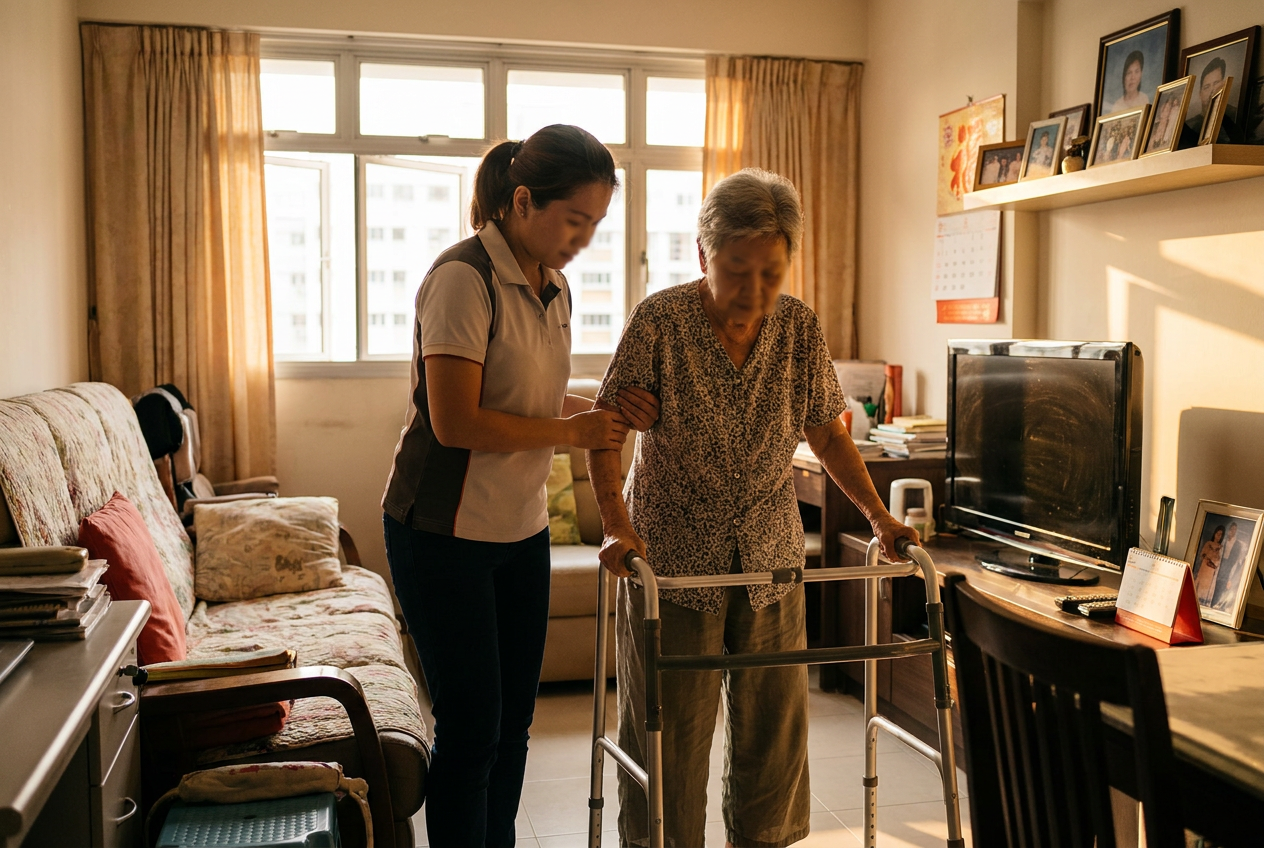
This guide is about the questions and verifications that genuinely matter when the placement is for eldercare. What 'eldercare specialist' actually means at agency level. How to read a biodata for eldercare suitability. Which training certifications are real, which are stamps. And the red flags that should make you walk away, even from a five-star Google-reviewed agency.
Reviewed by Yvonne, Placement Consultant at Upwill Employment Services (MOM EA Licence 24C2628).
Why eldercare placement is different from general placement
A general placement matches a helper to a household: housework load, number of children, cooking style, language preference. An eldercare placement matches a helper to one specific person with a specific medical condition, and the agency's job is harder by an order of magnitude.
Consider what changes when the elderly parent is the primary care recipient:
- The helper is doing clinical-adjacent work. Transferring a 70kg post-stroke parent from bed to wheelchair. Managing a urinary catheter. Recognising the difference between sundowning and a urinary tract infection. Knowing when to call the family versus when to call 995.
- Personality fit is medical, not preferential. A patient, soft-spoken helper is not a 'nice-to-have' for a dementia parent. It is the difference between a parent who eats and one who refuses food and loses 4kg in a month.
- The senior cannot advocate for themselves. If a helper is rough, neglectful, or simply mismatched, a healthy adult will say so. A frail 88-year-old with mild cognitive impairment often will not.
- Replacement disruption is severe. For a general household, swapping helpers means re-teaching the laundry routine. For a dementia parent, it can mean weeks of agitation, refused meals, and regression.
None of this is the agency's fault when it goes wrong, but a good eldercare agency builds its entire matching process around preventing these failure modes. A general agency simply doesn't. For the broader question of how to evaluate any agency, see our guide on how to choose a maid agency in Singapore; this article focuses on what's different when eldercare is the use case.
Features to look for in an eldercare-specialised agency
An agency that genuinely specialises in eldercare looks different from a general agency in concrete, observable ways. Use the list below as a sniff test on your first visit or call.
1. They ask about the senior before they ask about the household
The first 10 minutes should be about your parent: age, mobility, cognition, medications, last fall, any feeding tube, recent hospital admissions. If the first 10 minutes are about your salary range and how many bedrooms you have, you're at a general agency that also takes eldercare cases.
2. They keep eldercare-specific biodata, not a one-line tag
A general biodata says 'Experience: 2 years caring for elderly Sir, 80 yo, Singapore.' An eldercare biodata records the hours per week of direct eldercare, the specific conditions handled (dementia, post-stroke, Parkinson's, diabetes), the ADLs assisted, and whether there was hospital exposure (accompanying the senior to A&E, ward visits, discharge handovers).
3. They have a working relationship with AIC
The Agency for Integrated Care administers the levy concession, the Home Caregiving Grant, and certifies the senior's ADL status. An eldercare-focused agency knows the AIC case-manager hotline by heart, has handled dozens of ADL certifications, and will tell you which forms to submit on day one. Note that for an aged person 67 or older the S$60 concessionary levy applies automatically (no AIC ADL certification is needed) once the senior turns 67 and shares the same registered address; ADL certification is only required for the persons-with-disabilities route, such as an under-67 frail or disabled person certified as needing help with at least one ADL.
4. They run nationality-by-condition matching, not generic preference
Filipino, Indonesian, Myanmar. The differences matter more in eldercare than in general placement, and a specialised agency can articulate why for your specific scenario. Generic 'Filipinos speak better English' is not specialisation. (More on this in the nationality section below.)
5. They have post-placement clinical touchpoints, not just admin support
Most agencies offer 'support' that means 'we'll mediate if there's a salary dispute.' An eldercare agency offers a structured check-in at week 2, month 1, and month 3, focused on care quality: is the senior eating, sleeping, mobilising, accepting the helper? This is where genuine specialists are separated from claimants.
6. Honest replacement terms, in writing, eldercare-aware
Eldercare placements fail differently from general placements. A specialised agency understands that and offers replacement terms that reflect it (see the replacement section below).
Reading eldercare biodata properly
Biodata is where families either save themselves three months of pain or buy themselves into it. Most agencies present biodata in a standard MOM-style PDF that buries the eldercare-relevant fields. Force the conversation into specifics.
Hours, not years
'3 years eldercare experience' tells you almost nothing. The relevant question is: how many hours per week was she directly caring for the senior? A helper who lived with a working couple and cared for grandma 2 hours in the evening has very different exposure from one who was the sole caregiver for a bedridden 90-year-old, 14 hours a day. Ask the agency to extract the actual hours from the helper's previous-employer reference call. If they can't, ask why.
The specific conditions, named
Push past 'cared for elderly.' Ask:
- Was the senior bedbound, wheelchair-bound, walking with aid, walking unassisted?
- Were they cognitively intact, mildly forgetful, moderately demented, severely demented with sundowning?
- Were there any of: stroke, Parkinson's, diabetes (insulin-dependent vs oral), heart failure, COPD, cancer in active treatment, end-of-life?
- Any feeding tube (NG, PEG)? Catheter (indwelling, intermittent)? Wound care (pressure ulcer, post-surgical)?
- Did she ever transfer the senior alone? With a hoist? With another person?
A good agency will have asked these in the pre-screening interview and have notes. A weak agency will ad-lib answers on the spot, which is a major red flag.
Hospital exposure
This is the single most undervalued line in eldercare biodata. A helper who has accompanied her elderly charge to a hospital admission has been through a discharge briefing, has seen the difference between a tired senior and an acutely unwell one, and is calibrated for clinical escalation. A helper who has only ever cared for a stable senior at home is, through no fault of her own, calibrated for stability, not change.
The reference call
Ask whether the agency has actually called the previous Singapore employer (not the home-country agent). Ask what specifically came up. 'They said she was good' is not a reference; that's a paraphrase of a paraphrase. A real eldercare agency captures detail: 'previous employer said she was strong on bathing transfers but needed reminding on medication times.'
Caregiver Training Grant, AIC training, dementia-specific certifications
Training certifications in eldercare range from 'gold standard' to 'paid for the certificate.' Know the difference.
Caregiver Training Grant (CTG)
The CTG provides up to S$400 per care recipient (AIC-recognised providers), with a co-payment of at least S$10 per course. The subsidy is reimbursed directly to the approved training provider after the course is completed; the family or caregiver pays only the co-payment (at least S$10), so it is not a cash payout to the family. Courses cover ADL care, dementia care, post-stroke care, and similar topics.
What matters for agency selection:
- Has the helper's previous employer already used the CTG to put her through a course? That is a tangible signal. She has formal training, somebody invested in her.
- Will the agency help you claim the CTG and book the right course for your scenario in the first 3 months of placement? A specialised agency does this proactively.
- If the helper already has a CTG-sponsored certificate, ask which course, which provider, and when. The certificate should name the provider (e.g., NTUC LearningHub, ECON Healthcare, Touch Community Services).
AIC-recognised dementia training
For dementia placements specifically, look for completion of a structured dementia care course: the Dementia Singapore (formerly ADA) helper course, the AIC-curated Eldercare Training for FDWs, or equivalent. These are typically 2-5 day courses with practical assessment. A 1-hour webinar with a certificate is not the same thing.
Pre-placement mandatory training
Note that all first-time helpers in Singapore must complete the Settling-In Programme (SIP), but SIP is not eldercare training. It covers safety, regulations, and adjustment, not how to care for a person with dementia. Do not let an agency frame SIP as eldercare credential.
The certificate-checking habit
Ask for scans of all certificates. Verify the issuing body exists. For top providers, the certificate should include the course code, dates, and assessor's name. If the agency hesitates to provide scans, assume the certificate is questionable.
Best agency type by eldercare scenario
Not every eldercare agency is good at every scenario. Match agency strength to your parent's primary care need.
| Scenario | What the agency must do well | Signals to verify |
|---|---|---|
| Mild frailty, falls prevention | Match a patient, observant helper. Light clinical demands; bonding and reliability dominate. | Strong reference-call process; nationality match by personality not language. |
| Early-stage dementia | Source helpers with documented dementia experience; understand sundowning, agitation patterns. | CTG-sponsored dementia course; previous employer with diagnosed dementia (not just 'old'). |
| Advanced dementia, behavioural issues | Pre-screen for temperament; brief the helper before placement on specific triggers; offer post-placement coaching. | Agency runs a structured month-1 check-in; access to a registered nurse advisor; honest pushback if they think a helper isn't enough and a professional is needed. |
| Post-stroke maintenance | Helper with transfer, mobility, and possibly speech-therapy reinforcement experience. | Documented hours doing transfers; CTG post-stroke module; hospital-exposure history. |
| Diabetes / chronic disease management | Medication discipline, glucose monitoring, dietary control. | Helper has handled insulin-dependent senior; agency can produce previous medication chart photos (with names redacted). |
| Palliative / end-of-life | Honest assessment: most FDWs are not appropriate as sole caregiver. Agency should refer to home palliative + supplementary helper model. | Willingness to say 'this is not just a helper job', see helper vs professional caregiver. |
Best helper nationality for specific eldercare needs
Generalisations are imperfect. Every individual is different. But across thousands of placements, patterns emerge that are worth knowing when matching to a senior's condition.
Filipino helpers
Strongest English on average. Best fit for seniors who are cognitively intact, communicative, and used to professional carer interaction. Many Filipino helpers come from healthcare-adjacent backgrounds (former nursing aides, midwives). Good for post-stroke seniors where verbal cueing matters during physiotherapy practice. Salary band sits at the upper end (S$650-800).
Indonesian helpers
Often exceptionally patient and unflappable, which matters enormously in dementia care. Many have prior experience with multi-generational households in Indonesia and are comfortable around frail elders. English may be weaker on placement but typically improves quickly. Salary band S$600-750.
Myanmar helpers
Growing pool, with a reputation for gentleness and persistence. Particularly suited to soft-spoken Chinese-speaking households (many Myanmar helpers pick up Mandarin quickly through Burmese-Chinese family contact). English usually requires patience in months 1-3. Salary band S$580-700. For agency-specific guidance see our Myanmar maid agency guide.
Indian helpers
Smaller pool but growing. Often have caregiving backgrounds and bring strong household management skills. Good for Tamil- or Hindi-speaking grandparents. See our Indian maid agency guide for sourcing specifics.
For nationality, the question is not 'which is best'. It is 'which is best for this senior's condition and household.' A good agency walks you through that trade-off honestly. A weak agency tells you whichever nationality they happen to have in stock is the best.
The eldercare-specific interview: what to actually ask candidates
If you do a video interview with a candidate (you should), skip the generic 'tell me about yourself' and go straight to scenarios. The goal is to surface judgement, not test scripted answers.
- 'Your previous employer's mother fell in the bathroom. What did you do, in order?' You're listening for: did she check the senior before moving her? Did she call the family? Did she know whether to call 995?
- 'The senior refuses to eat breakfast and says she already ate. What do you do?' Tests dementia handling. Good answer: re-approach 15-30 minutes later in a different framing; do not argue or insist.
- 'How do you know if a urinary catheter is blocked?' Tests actual clinical exposure. A helper with real catheter experience will mention urine flow, bladder fullness, leakage around the tube.
- 'Show me how you would help me stand up from this chair' (on video, you stand and act out frailty). Tests transfer technique. She should not pull on your arms. She should brace, support at the hips/torso, and use her own body.
- 'What time does your previous Ma'am take her medication, and what is it for?' Tests recall and engagement. A helper who genuinely cared will know, even imperfectly.
- 'What is the hardest part of caring for an elderly person?' Tests self-awareness. The wrong answer is 'nothing, I love it.' Honest answers: 'when she does not recognise me,' 'when she falls,' 'changing her in the night when she is tired and resists.'
Take notes. Compare across candidates. The right helper for an eldercare role is almost always recognisable in interview.
Replacement guarantees: why they matter more in eldercare
For a general placement, a free replacement within 6 months is a nice-to-have. For an eldercare placement, it is structurally important, and the standard 6-month free replacement is often inadequate.
Eldercare placement failure modes are different:
- Slow-burn mismatches. The helper isn't bad, but the senior isn't thriving. Weight is dropping. Sleep is disturbed. The signs take 3-4 months to register, by which point general agencies have moved past the free-replacement window.
- Helper burnout. Caring for a high-acuity senior is physically and emotionally exhausting. A helper who looked perfect at month 1 may need rotation by month 9. A senior-focused agency factors this in.
- Condition deterioration. Your parent's needs at month 1 may not match needs at month 12. A specialist agency offers an upgrade path: swap the helper for one with higher-acuity experience, without restarting fees from zero.
What to ask for in writing:
- Free replacement window of at least 6 months, with a clear definition of 'failed placement' that includes the senior's wellbeing markers (not just helper performance complaints).
- Pro-rated credit on the agency fee for the next placement if the failure is between month 6 and month 12.
- An explicit clause that allows replacement for 'no fault' reasons in eldercare contexts, e.g. the senior is not bonding, despite the helper performing competently.
Eldercare agency red flags
- Every biodata is labelled 'eldercare experienced.' Statistically impossible. A genuine agency has perhaps 20-40% of its pool with real eldercare experience.
- The agency cannot name a specific CTG-approved course or AIC training programme. They are not specialists.
- Pricing the eldercare service identical to general placement. Real eldercare matching takes more pre-screening, more reference calls, more interview time. If you're paying the same as a housekeeping placement, you're getting one.
- 'No need to interview, this one is very good for old people.' Always interview. An agency that discourages interviews is hiding something.
- No discussion of the levy concession or HCG. An eldercare specialist brings these up in the first meeting because they save the family S$240/month from day one.
- Pressure to sign the same day. A good eldercare match is worth a week of consideration; if the helper is the right fit, she'll still be available.
- Heavy reliance on online reviews without offering a face-to-face visit. The agency office, the way staff handle a walk-in family, the visible filing system. These tell you more than any review.
Upwill's eldercare placement service
Upwill (MOM EA Licence 24C2628) runs a structured eldercare placement track. We pre-screen biodata for documented eldercare hours and named conditions, conduct reference calls with previous Singapore employers, and run a candidate shortlist that reflects your parent's specific scenario, not just availability. We handle the AIC ADL certification where it applies (the S$60 concessionary levy is automatic once the senior is 67 or older and shares your registered address; ADL certification is needed for the under-67 disability route), brief shortlisted helpers on your parent's profile before your video interview, and run structured check-ins at week 2, month 1, and month 3 post-arrival. We are honest when a case is beyond the helper model. We will tell you to look at professional home care if that's the right call. See our maid agency for elderly care for the full process. For insurance, we pair every eldercare placement with an upgraded medical and PA policy. See helper insurance and the deeper guide on eldercare maid insurance.
Eldercare agency selection checklist
Use this before signing with any agency. If you cannot tick most of these, keep looking.
- Agency asked detailed questions about the senior's condition before discussing fees.
- Biodata provided shows hours of eldercare experience, named conditions, and ADL specifics, not just 'cared for elderly.'
- Agency can name the AIC case-management hotline and offers to handle ADL certification for the levy concession.
- Agency can produce CTG-sponsored or AIC-recognised training certificates for shortlisted helpers, with course names and providers.
- Reference call notes (not summaries) from previous Singapore employer available for inspection.
- Agency proposes nationality match with a stated reason tied to your parent's condition.
- Replacement terms in writing extend to at least 6 months with eldercare-specific 'no-fault' clauses.
- Structured post-placement check-in schedule (week 2, month 1, month 3) is documented.
- Agency is willing to say 'this case may need a professional caregiver, not just a helper' if applicable.
- You did not feel rushed to sign on the first visit.
For broader agency comparison and MOM ratings, see our MOM-rated maid agency list.
Reviewed by
Yvonne, EA Personnel, Upwill Employment Agency. MOM EA Licence 24C2628. She holds the MOM Certificate of Employment Intermediaries (CEI) and is a regular liaison with AIC case managers on FDW eldercare placements.
Last reviewed: May 2026. Information is general guidance, not financial or medical advice. Programme details verified against AIC and MOM public schemes as of April 2026.