Indian Maid Agency Singapore 2026: How to Choose, Costs, Salary, Source-Country Process
TL;DR: An Indian maid agency in Singapore places Tamil, Malayalam or Hindi-speaking helpers for vegetarian kitchens and Tamil-language eldercare. Expect a salary of S$550 to S$850, an eight to twelve week India-side process, and always verify the agency's MOM EA Licence first.
Indian helpers make up less than five per cent of Singapore's foreign domestic worker (FDW) supply, which makes the segment small, specialised and difficult to navigate. Yet for a growing number of Singaporean Indian and mixed-heritage families, an Indian maid agency in Singapore is the only realistic route to a helper who can cook a proper sambar, speak Tamil or Malayalam to an elderly parent, and respect a vegetarian or Hindu household by default. This 2026 guide explains how the placement actually works on both sides of the Bay of Bengal (Singapore's MOM rules and the India-side process under the Ministry of External Affairs) so you can hire with eyes open.
Reviewed by Yvonne, Placement Consultant at Upwill Employment Services (MOM EA Licence 24C2628). Information current as of 2026.
Why Singapore families choose Indian helpers
For most Singaporean households, the default FDW source country is the Philippines, Indonesia or Myanmar, and for good reason. The supply is deep, the agency networks are mature, and salaries are well understood. Indian helpers occupy a different niche. Families who deliberately seek out an Indian maid agency in Singapore usually have at least one of three needs:
- Language continuity for an elderly parent. A grandmother who speaks Tamil, Malayalam or Hindi at home cannot have a meaningful relationship with a helper who only speaks Bahasa or Burmese. For dementia care in particular, the helper's mother tongue often becomes non-negotiable.
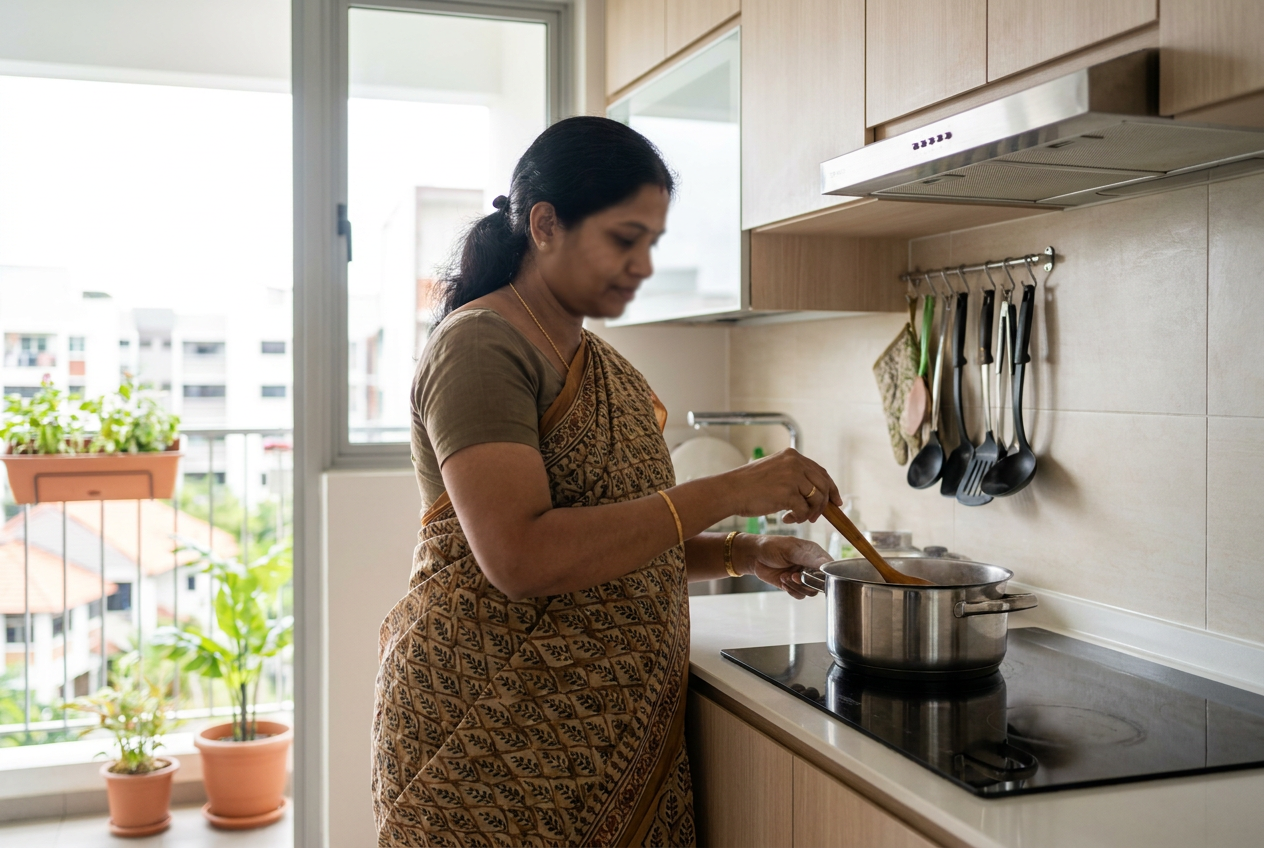
- Strict vegetarian or Jain kitchens. A helper raised in a vegetarian household in Tamil Nadu, Kerala or Gujarat understands the distinction between onion-garlic and Jain vegetarian without coaching, and won't accidentally cross-contaminate utensils.
- Religious and cultural fit. Hindu festival fasting, pooja-room cleanliness rules, and South Indian wedding-season cooking are easier with a helper from the same broad cultural background.
None of these reasons are exclusive to Indian helpers. Many Filipino and Myanmar helpers cook excellent Indian food after training. But where the household speaks Tamil or Malayalam as a first language, the pool naturally narrows to India. See our Filipino vs Indonesian vs Myanmar maid comparison for context on the larger source countries.
Typical Indian helper profile
The Indian helpers who reach Singapore are not a uniform group. They come from a handful of specific states and language regions, and understanding the breakdown helps employers ask the right questions.
| State of origin | Primary language | Typical strengths |
|---|---|---|
| Tamil Nadu (Chennai, Madurai, Coimbatore) | Tamil | South Indian cooking, Tamil eldercare, Hindu household familiarity |
| Kerala (Kochi, Thiruvananthapuram) | Malayalam (often English-fluent) | Nursing-style eldercare, English communication, coastal cooking |
| Karnataka (Bengaluru, Mangalore) | Kannada, often Tamil/Hindi | Urban household experience, mixed cuisine |
| Andhra Pradesh / Telangana | Telugu | Spice-forward South Indian cooking |
| North India (Punjab, Delhi NCR, UP) | Hindi, Punjabi | North Indian cuisine, roti/paratha, Punjabi households |
English fluency is generally higher among helpers from Kerala and urban Tamil Nadu than from rural North India. Most Indian helpers placed in Singapore are between 30 and 45 years old, partly because of the Indian government's own age rules (more on that below), and partly because experience is what makes a helper marketable in a small pool.
Indian helper salary norms 2026
Singapore does not set a statutory minimum wage for FDWs. Source countries set their own floors and the market does the rest. For Indian helpers in 2026, the practical bands are:
- Entry-level (first contract, limited English): S$550-S$650 per month.
- Mid-tier (some Singapore or Gulf experience, conversational English, basic Indian cooking): S$650-S$750 per month.
- Experienced (multiple Singapore contracts, eldercare or strong cooking, fluent English): S$750-S$850 per month.
- Specialist (registered nurse background, dementia care, transfer helper with strong references): S$850-S$1,000+.
These bands sit slightly above Myanmar helpers and slightly below Filipino helpers on average. Add the standard S$300 monthly FDW levy (S$60 concessionary), insurance, and the S$5,000 security bond, and the total monthly cost of an Indian helper in 2026 sits around S$900-S$1,150. For a full cost stack see our 2026 hiring cost guide and the domestic helper salary guide.
Verifying an Indian maid agency in Singapore
This is the step most families skip and most regret. Any agency placing a helper in Singapore, regardless of source country, must hold a valid MOM Employment Agency (EA) Licence. Verify before signing anything:
- Ask for the EA Licence number. It looks like XXC#### (for example, Upwill's licence is 24C2628).
- Cross-check it on the MOM EA Directory at mom.gov.sg/eadirectory. The directory shows the licence status, the Key Appointment Holder, and any past demerit points.
- Check that the agency's physical office address matches the directory entry. A licensed EA must operate from a registered premises.
- Ask which India-side training centre or recruitment partner the agency uses. A reputable agency will name a specific centre in Mumbai, Chennai or Delhi, not deflect.
- Read the in-principle contract before paying any deposit, and make sure the agency fee, transfer of helper clause, and replacement policy are all spelled out.
Indian helpers are sometimes placed by smaller, sole-proprietor agencies that specialise only in this corridor. That is fine (small does not mean unsafe) but the MOM licence check is non-negotiable either way.
India-side process: eMigrate and the Protector of Emigrants
India regulates the outbound flow of its workers through the Ministry of External Affairs (MEA) and a system called eMigrate, with regional Protector of Emigrants (PoE) offices handling clearances. A few points matter for Singapore-bound helpers:
- Singapore is not on India's ECR list. Emigration Check Required (ECR) status is reserved for 17 countries (the Gulf states plus several South and Southeast Asian and North African countries) where India considers worker grievance redressal weak. Singapore is treated as a safer destination, so a formal PoE emigration clearance sticker is generally not mandated for a Singapore-bound FDW.
- Age rule applies only to ECR countries. India's ban on emigration clearance for women below 30 years of age for domestic work abroad applies only to ECR destinations. India's MEA states it does not apply to women going to non-ECR (ECNR) countries, so it does not legally apply to Singapore-bound helpers. In practice, most Indian helpers you meet in Singapore are still 30 or above because experience is what makes a helper marketable in a small pool.
- Recruiting Agent (RA) registration. The Indian recruitment partner that sources the helper should hold a valid RA licence from the Protector General of Emigrants, registered on the eMigrate portal. Ask your Singapore agency for the RA's name and registration number.
- Passport and visa. The helper's passport must have at least six months' validity, and the Singapore Work Permit In-Principle Approval (IPA) is issued by MOM before she flies.
- Training centres. Most India-side training happens in Mumbai, Chennai, Bengaluru or Delhi, typically 15 to 30 days of household-skills, cooking and basic English instruction before deployment.
Vegetarian cooking and religious compatibility advantages
This is the most under-rated reason to hire through an Indian maid agency. A helper who grew up in a vegetarian household in Tamil Nadu or Gujarat understands instinctively:
- That onion and garlic are excluded in Jain and some Vaishnav kitchens.
- That utensils used for meat in a previous job cannot enter a strict vegetarian kitchen without being replaced.
- That pooja-room cleaning has its own rules: no leather slippers, hands washed first, a specific order of wiping.
- That Hindu festival days (Karthigai Deepam, Navaratri, Pongal, Diwali) carry fasting and cooking rules that change the weekly routine.
None of these are impossible to teach a helper from another country, but the training time is real, typically four to eight weeks of close supervision. With an experienced Indian helper, you usually skip that ramp.
Tamil-language eldercare specialisation
The single strongest case for an Indian helper is eldercare for a Tamil-speaking grandparent. A few practical realities:
- A Tamil-speaking elder with early dementia loses second languages first. English and Mandarin go before Tamil does. A non-Tamil helper quickly becomes invisible to the patient.
- Medication compliance depends on the helper being able to explain, in Tamil, why a tablet is being given.
- Cultural cues, such as calling the elder Amma or Appa, knowing not to offer food during a religious fast, recognising a Tamil hymn on the radio, all build the trust that makes 24-hour care viable.
If eldercare is the primary need, prioritise helpers with documented elderly-care experience and ask the agency to arrange a video interview in Tamil specifically.
Challenges: smaller pool, longer processing, fewer agencies
Honesty about the downside is part of a fair guide. Hiring an Indian helper in Singapore in 2026 comes with real friction:
- Smaller candidate pool. Where a Filipino or Indonesian agency might show you 30 profiles in a week, an Indian agency might show three. Plan for a longer shortlist phase.
- Longer processing. The India-side paperwork (passport, training, RA processing, IPA) often runs eight to twelve weeks, sometimes longer. Don't book a hospital discharge or a return-to-work date assuming a fast turnaround.
- Fewer specialist agencies. Many Singapore agencies dabble in Indian placements but only a handful do it as their core business. Ask how many Indian helpers the agency placed in the last 12 months. A serious answer is in the dozens, not single digits.
- Pricing variance. Because the pool is small, agency fees for Indian placements can be 10-20 per cent higher than for Filipino or Myanmar helpers.
- Transfer helpers are rare. If you want an in-Singapore transfer helper (already on a Work Permit, finishing a previous contract), the Indian pipeline is thin. Most placements are fresh from India.
For comparison with another niche source country, see our Myanmar maid agency guide.
Selection checklist
- Confirm the agency's MOM EA Licence on the EA Directory.
- Ask for the India-side Recruiting Agent (RA) name and eMigrate registration.
- Specify mother tongue (Tamil / Malayalam / Hindi / Telugu) up front, not just "Indian".
- For eldercare: insist on documented experience and a Tamil/Malayalam video interview.
- For vegetarian / Jain kitchens: confirm the helper's own dietary background, not just willingness.
- Verify the helper is 30 or above and that her passport has at least six months' validity.
- Ask for the IPA estimated timeline in writing. Eight to twelve weeks is normal, anything under four weeks is a red flag.
- Review helper insurance options before the helper arrives. The policy must be in place on day one.
- Read the replacement clause carefully. Indian helper replacements take longer because the pool is smaller.
- Plan for a six-to-eight-week settling-in period. Indian helpers, especially first-timers, take time to adjust to HDB living and Singapore pace.
Hiring an Indian maid in Singapore is not for every household, but where the household language is Tamil or Malayalam, the kitchen is strictly vegetarian, or eldercare for a South Indian grandparent is the priority, no other source country comes close on cultural fit.
Reviewed by Yvonne, Upwill Employment Agency. MOM EA Licence 24C2628. This article is general guidance; for case-specific advice, contact our placement team via maid placement services.