Caregiver Singapore 2026: Live-In Helper vs Professional Home Care, Costs Compared
TL;DR: The right caregiver choice in Singapore depends on the senior's needs. A live-in migrant domestic worker (MDW) trained in eldercare suits long-term, moderate care, and the levy drops from S$300 to S$60 a month when a Singapore Citizen aged 67 or above lives with you. Professional home care suits complex or clinical needs and is priced by the hour. Many families combine both, and from 2026 the Home Caregiving Grant pays up to S$600 a month and MOH home care subsidies reach up to 95% for older citizens. Updated 22 September 2026.
Every Singapore family hitting the eldercare wall faces the same fork in the road. Mum has had a fall. Dad's dementia is escalating. The hospital is talking about discharge planning. And somewhere between the case manager's brochures and a frantic WhatsApp chat with siblings, two very different options surface: hire a live-in domestic helper for eldercare, or engage a professional caregiver from a home-care provider.
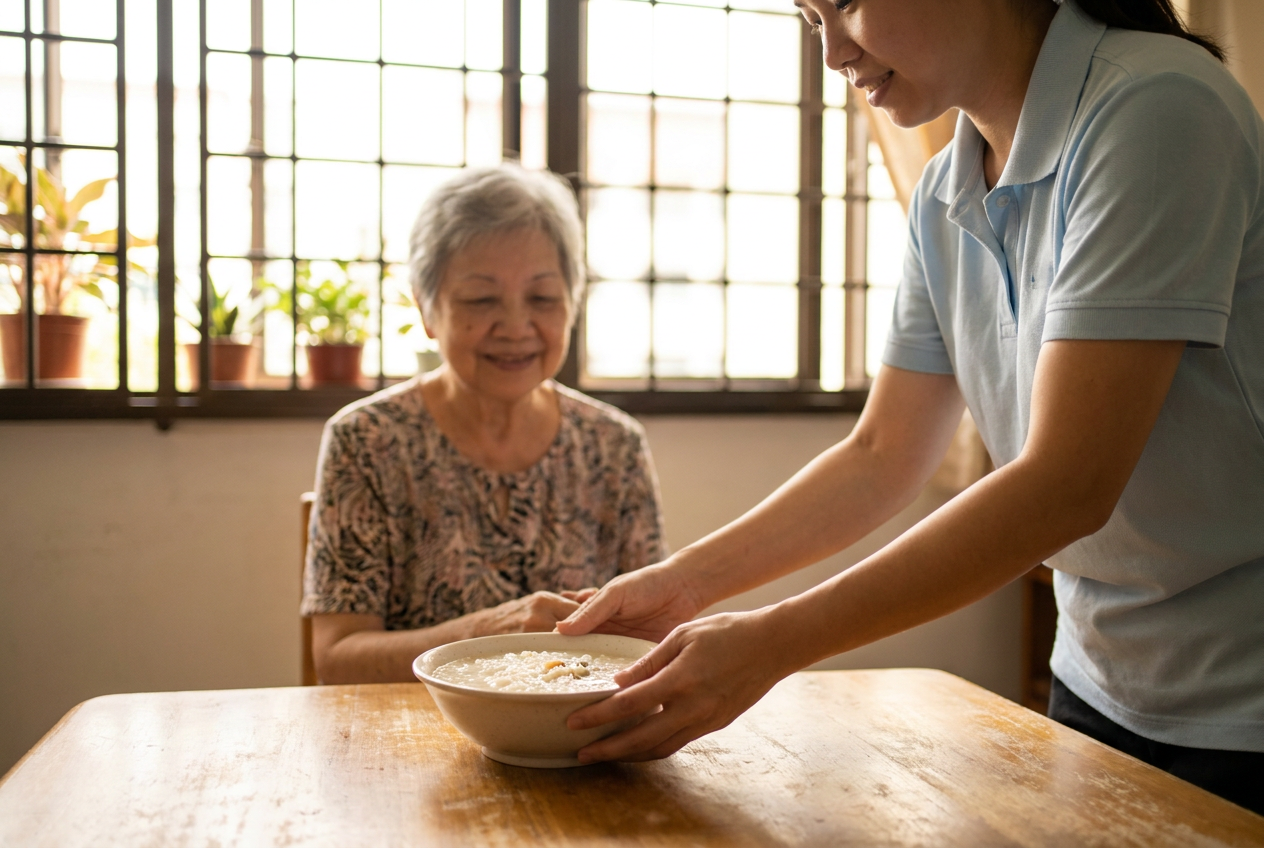
The two options solve different problems. A helper gives you a person in the home every day; a professional gives you trained, supervised care in set blocks of time. This guide breaks down what each path actually delivers in 2026, who pays for what, which government support applies, and how to decide for your specific scenario.
Reviewed by Yvonne, Placement Consultant at Upwill Employment Services (MOM EA Licence 24C2628).
Cost snapshot: caregiver Singapore options at a glance
Here is how the three most common elderly home care Singapore arrangements are priced in 2026. Figures are taken from MOM and from providers' own published price lists; check the latest rates before you commit.
| Option | How it is priced | Includes | Best For |
|---|---|---|---|
| Live-in domestic helper for eldercare | Her monthly salary (agreed with you), plus levy of S$60 a month with a levy concession (S$300 without), mandatory insurance, a S$5,000 security bond, food, lodging and all her medical costs | Daily presence, help with activities of daily living (ADLs), household work, companionship | Long-term moderate-needs care, frailty, mild dementia, post-stroke maintenance |
| Hourly professional home care | Per hour. Example: Homage lists ADL caregiver visits from S$27.50 to S$28 an hour on weekdays and ADL plus simple nursing from S$33 an hour for weekday visits of 3 hours or more (S$34 for 1 to 2 hours) (Homage pricing). NTUC Health lists subsidised home personal care from S$4.80 an hour (NTUC Health) | Trained care staff in set visit blocks | Respite, post-hospital recovery, bathing help, supplementing a helper |
| HSS basic elder-minding | Quoted by each company on MOM's list | Intermittent basic elder-minding, such as help with bathing, feeding, walks and prescribed medication | Families who need occasional, non-clinical help |
A live-in helper is a monthly cost; professional care is an hourly one. The more hours of support a senior needs each week, the more the maths tilts towards a helper, with professionals brought in for the clinical parts.
The domestic helper as caregiver: what you're actually getting
The most common caregiver Singapore arrangement is a migrant domestic worker on a MOM Work Permit, hired with eldercare as her main role.
What an eldercare helper costs you each month (2026)
- Salary: agreed between you and the helper and written into her contract. See our 2026 salary benchmarks.
- Levy: S$60 a month under the levy concession, instead of the normal S$300 for a first helper or S$450 for each subsequent helper (MOM levy rates). For a Singapore Citizen aged 67 or above living at the same address, the concession applies automatically. A person with disabilities qualifies if a Singapore-registered doctor certifies they need help with at least one ADL, with a recommendation letter from AIC. See our full FDW levy guide.
- Insurance: medical insurance with an annual claim limit of at least S$60,000 and personal accident cover of at least S$60,000 (MOM insurance requirements). See eldercare maid insurance Singapore.
- Upkeep: three meals a day, accommodation that meets MOM's standards, and all her medical costs.
Upfront, you also need the S$5,000 security bond and the costs of bringing her in. For a deeper breakdown see our total cost to hire a maid in Singapore guide.
What the helper can actually do
With good training and clear instructions from the family and the senior's doctors, an eldercare helper can typically:
- Assist with the six ADLs (washing, dressing, feeding, toileting, transferring, moving around)
- Give prescribed medication as instructed, with family supervision
- Check blood pressure or blood sugar if trained to use the device
- Accompany seniors to clinic appointments
- Handle the rest of the household: cooking, cleaning, laundry
What she cannot do: replace clinical nursing judgement, manage acute medical crises alone, or perform procedures that need a nurse.
Training help from AIC: the Caregivers Training Grant covers approved caregiving courses for the main caregiver, and AIC confirms a domestic helper qualifies if she is the main person caring for a Singapore Citizen or PR aged 65 and above or with a disability. It starts with S$400, is topped up by S$200 each financial year, and the balance is capped at S$400. A co-payment of at least S$10 per course applies.
Trade-offs honest families flag
- Language and settling-in take time. English levels vary by individual, so interview for it rather than assuming by nationality. See our nationality comparison
- One person doing two jobs (eldercare and housework) means neither gets undivided attention
- The senior may take time to bond with someone who does not share their language or culture
- Limited clinical depth. A trained helper is not a nurse
Professional home care providers in Singapore
Home care in Singapore ranges from app-based providers to government-funded community providers. A few reference points, each from the provider's or government's own page:
- Homage: pay-as-you-go ADL caregiver visits from S$27.50 to S$32 an hour depending on day, time and visit length, ADL plus simple nursing from S$33 an hour for weekday visits of 3 hours or more (S$34 for 1 to 2 hours), and complex nursing from S$80 per procedure (Homage pricing).
- NTUC Health: subsidised home personal care from S$4.80 an hour for 1 to 3 hour sessions, with subsidised personal care capped at 360 hours a year (NTUC Health home care).
- HSS elder-minding companies: MOM's list of companies approved for basic elder-minding (PDF) includes Homage, Jaga-Me and Active Global Respite Care, among others.
What a professional caregiver brings that a helper doesn't
- Formal caregiving or nursing training
- Supervision within a provider that can escalate to nurses
- Care that can be matched to the senior's language
- Substitutability: if one caregiver is unavailable, the provider can send another
The catch: you pay by the hour, and you still need to cover housework and overnight presence separately.
Part-time caregiver Singapore: when hourly visits make sense
A part-time caregiver Singapore arrangement (a few scheduled visits a week) suits a specific family profile: the senior still lives semi-independently or with family, but needs scheduled help. Common use cases:
- Post-hospital discharge. Regular visits during the recovery window, then stepping down
- Bathing and grooming only. Family handles most care, but bathing a parent with limited mobility is a two-person job
- Respite for the primary caregiver. An adult child works full-time and needs daytime gaps covered
- Trial before committing. Test professional care before deciding whether to hire a live-in helper
Typical part-time caregiver Singapore budget
As a worked example at Homage's published weekday rate of S$27.50 an hour for visits of 3 hours or more: 4 visits a week × 3 hours × S$27.50 = S$330 a week, or about S$1,430 a month before any subsidy or grant. The Home Caregiving Grant (below) can offset part of this for eligible families. Subsidised home personal care from government-funded providers costs far less for eligible households, because MOH means-tested subsidies apply.
Live-in professional caregiver: when to pay the premium
A live in caregiver Singapore arrangement using a professional rather than a domestic helper is usually the most expensive option, and prices are set by each provider, so get written quotes. It solves problems a helper cannot.
When the premium is worth it
- Senior has complex medical needs. Advanced dementia with severe sundowning, multiple conditions, tube feeding or tracheostomy care
- Palliative or end-of-life care. Clinical needs escalate quickly; a trained caregiver working with a home palliative team is safer
- Family wants no household-work conflict. The caregiver focuses entirely on the senior; a separate cleaner handles the home
- Language or cultural match matters more than budget. A caregiver who speaks the senior's dialect can make a real difference
CareShield Life, AIC grants and MOH subsidies in 2026
Government support changed materially in 2026. Most families underestimate what they qualify for.
Home Caregiving Grant (HCG)
From April 2026, the HCG pays up to S$600 a month (up from S$400) and covers more households, with the income limit raised from S$3,600 to S$4,800 per person. The monthly amount depends on monthly household income per person (AIC):
- S$1,500 or less: up to S$600
- S$1,501 to S$3,600: S$400
- S$3,601 to S$4,800: S$200
Other conditions: the care recipient is a Singapore Citizen, or a PR with a living Singapore Citizen parent, child or spouse; lives in Singapore and not in a residential long-term care institution; and permanently needs some assistance with at least 3 of the 6 ADLs. AIC says the grant can be used for care needs such as hiring a helper, paying for home care services, or buying healthcare items. Apply through AIC's eFASS with Singpass, or call AIC on 1800-650-6060. For details see our Home Caregiving Grant guide.
MOH home care subsidies (from 1 July 2026)
MOH's subsidy framework for non-residential long-term care covers home personal care, home nursing, home medical, home therapy, dementia day care and more. From 1 July 2026, subsidies go up to 80% for Singapore Citizens, up to 95% for citizens born in 1969 or earlier, and up to 55% for PRs, depending on household income per person. Households above S$4,800 per person get no subsidy. These subsidies apply at government-funded providers, so ask the provider whether a service is MOH-subsidised.
CareShield Life
CareShield Life pays a monthly cash payout for life once a policyholder is assessed as severely disabled. MOH says the payout for someone who starts claiming in 2026 is S$689 a month, and from 2026 to 2030 the payout level rises by 4% a year instead of 2% (MOH announcement on the CareShield Life Council recommendations). Many of today's seniors are covered by the older ElderShield scheme instead, which pays according to its own policy terms, so check which scheme your parent is on.
MediSave Care and ElderFund
- MediSave Care: people with severe disability can withdraw up to S$200 a month from MediSave to reduce out-of-pocket care costs (MOH).
- ElderFund: up to S$250 a month for Singapore Citizens aged 30 and above who need full assistance with at least 3 ADLs, with household income of S$1,500 or less per person and less than S$10,000 in MediSave, and who are not CareShield Life or ElderShield policyholders (AIC ElderFund).
Each scheme has its own eligibility test, so check each one separately. AIC's care advisors (1800-650-6060) can tell you which apply to your family and whether they can be combined.
The hybrid model: helper plus professional respite
Many families are not picking one path. They are combining.
The typical hybrid setup:
- Live-in domestic helper handles the day-to-day: ADLs, meals, companionship, household
- Professional visits a few hours a week for specialised tasks: wound care, therapy follow-up, or simply to give the helper and family a structured break
- Day care a few days a week (optional) for socialisation. Dementia and maintenance day care are included in MOH's subsidy framework
The senior gets clinical oversight without losing daily care, the helper learns from the visiting professional, and the family has a fallback when the helper is on her rest day or home leave.
Decision framework: which path for which scenario
Use the scenarios below as a starting point. Every family is different, and a conversation with an AIC care advisor (1800-650-6060) is worth more than any web table.
Mild frailty, no major medical issues
Recommended: A live-in helper alone is usually enough. Professional visits are rarely needed.
Post-stroke, stable but needs maintenance
Recommended: Helper plus a regular therapy or professional caregiver visit. The helper reinforces the exercise plan daily; the professional adjusts it.
Early-stage dementia
Recommended: A patient, well-briefed helper plus a few days a week at a dementia day care centre.
Advanced dementia with sundowning, wandering, behavioural issues
Recommended: Professional care, possibly with overnight cover, or a helper supported by substantial professional input. A helper alone is rarely sufficient, and burnout risk is very high.
Post-hospital recovery (a few weeks)
Recommended: Part-time professional visits during the recovery window. Once stable, step down to family or a helper.
Palliative care at home
Recommended: Ask the hospital team or AIC about home palliative care services, supplemented by a live-in helper or caregiver for daily needs.
Respite while the primary caregiver is away
Recommended: Short-term professional caregiver bookings, HSS basic elder-minding for non-clinical help, or respite care arranged through AIC. Hiring a new helper is not a quick fix for a few weeks: it takes an application, a security bond, insurance and time for her to arrive.
If you choose the helper eldercare path: how Upwill helps
For many Singapore families, a live-in helper supported by the right grants is the most sustainable way to care for a parent at home. If that's the path that fits, here's how Upwill (MOM EA Licence 24C2628) helps with Indonesian, Filipino and Myanmar helpers:
- Eldercare-focused shortlisting. We help you shortlist helpers with eldercare experience and interview for it properly. See our eldercare helper service page
- Levy concession guidance. We explain which concession route applies to your household, so you pay S$60 instead of S$300 where you qualify
- Insurance options. We walk you through the mandatory cover and optional upgrades via our helper insurance. Worth reviewing when your helper will be lifting and transferring a senior daily
- Salary benchmarking. We help you set a fair offer. See our 2026 salary benchmarks
- Grant signposting. We point you to AIC for the Home Caregiving Grant and the Caregivers Training Grant
If you're still weighing helper vs professional, talk to us before committing either way.
Reviewed by
Yvonne, Placement Consultant, Upwill Employment Services. MOM EA Licence 24C2628.
Last reviewed: 22 September 2026. Information is general guidance, not financial or medical advice. Subsidy and grant figures checked against MOM, MOH and AIC pages in September 2026; provider prices are taken from each provider's own website and may change.