Confinement Nanny vs Maid Singapore: Which Do You Actually Need? (2026 Buyer's Guide)
TL;DR: A confinement nanny in Singapore is a short-term (28-44 day) live-in post-partum specialist costing S$3,200 to S$8,500, while a maid (MDW) is a two-year general household worker on an MOM Work Permit. They are not substitutes; many families hire both.
Almost every first-time Singapore parent who Googles "help with a newborn" eventually hits the same fork in the road: should we hire a confinement nanny for the post-partum month, or a maid (Migrant Domestic Worker) on a two-year Work Permit, or both? They sound interchangeable. They are not. They are two completely different roles, on two completely different visas, at two completely different price points, doing two completely different jobs.
This guide unpacks the confinement nanny vs maid Singapore decision the way a licensed employment agent would walk a young couple through it in the office: scope, cost, legal status, cultural fit, and the hybrid arrangement most modern Singapore families end up landing on. Upwill is an MOM-licensed maid agency (EA Licence 24C2628); we place MDWs, not confinement nannies, so this article is a neutral buyer's guide rather than a sales pitch for one side.
Reviewed by Yvonne, Placement Consultant at Upwill Employment Services (MOM EA Licence 24C2628). Last reviewed May 2026.
1. The real difference in one sentence
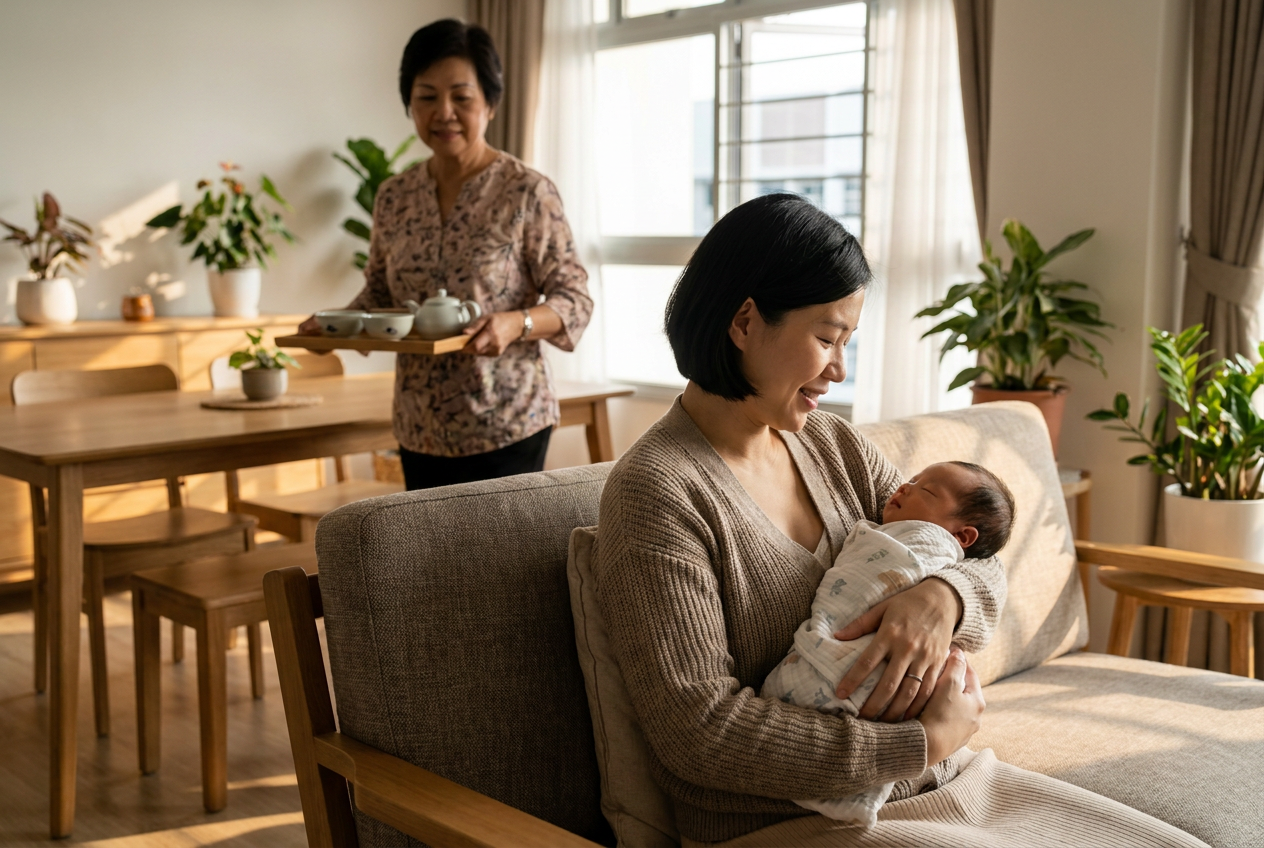
A confinement nanny (Hokkien: pue yue; Mandarin: yue sao, 月嫂) is a short-term, live-in post-partum specialist hired for the 28-day Chinese confinement month or the 44-day Malay pantang tradition. A maid, properly called a Migrant Domestic Worker (MDW) or Foreign Domestic Worker (FDW), is a two-year, MOM-regulated general household worker on a Work Permit. The nanny is a sprint; the maid is a marathon. They are not substitutes for each other, and choosing the wrong one for your situation is the most expensive newborn mistake we see.
2. What a confinement nanny actually does
A confinement nanny's job is bounded, both by tradition and by what your family pays her for. Her scope is the mother and the baby for one specific window of recovery, and she does almost nothing else.
The two main traditions
- Chinese confinement (28 days): the classic zuo yue zi month. Restorative meals, herbal supplements, no cold water, no hair washing for the first week (some families relax this), heavy emphasis on warming foods, ginger, sesame oil, red dates and rice wine.
- Malay confinement (44 days): berpantang, longer in duration, with traditional bertungku (warm stone abdominal compress), bertangas (herbal steam), jamu herbal tonics and post-natal massage by a bidan.
- Indian confinement (40 days): similar 40-day window, oil massages, special diet, often handled by family rather than a hired nanny, but Indian-trained confinement helpers do exist in Singapore.
Mother care
Red dates tea, ginger soup, fish papaya soup for milk supply, pork trotter vinegar stew, herbal sitz baths and warm-compress care, latching support, lactation troubleshooting, and emotional reassurance during the baby blues window are all standard. A good nanny will also enforce rest, physically stopping a new mother from running around the house when she should be horizontal.
Baby care
24/7 newborn care including night feeds (formula or expressed breast milk), swaddling, burping, bathing, umbilical-cord stump care, soothing colic, gentle baby massage, and basic sleep training cues. Many experienced nannies have cared for a large number of newborns over their career, far more newborn-specific volume than the average maid will ever see.
What a confinement nanny will not do
She does not do general housework. She will not vacuum, mop, do the family's laundry, cook for older siblings or in-laws, or look after toddlers. Her scope is mother + newborn only; that's why she costs what she costs.

Leaning toward a live-in helper? Upwill is a maid agency for infant care (MOM EA Licence 24C2628): we match helpers with verified newborn and infant experience, checked against their MOM employment history, and can plan the confinement-nanny handover with you.
3. What a maid (MDW) actually does
An MDW on a Work Permit is a generalist on a two-year contract: MOM-regulated, levy-paying, with a security bond, mandatory medical insurance, weekly rest day and a host of statutory protections (see our first-time employer checklist). Her duties typically include:
- General housework: sweeping, mopping, laundry, ironing, bathroom cleaning.
- Daily cooking for the whole family, including grocery shopping.
- Childcare for infants, toddlers and school-going children.
- Eldercare for grandparents at home.
- Light pet care.
An experienced MDW can absolutely care for a newborn: bathing, bottle-feeding, changing, settling. What she usually does not have is deep, traditional post-partum knowledge: she will not know how to brew the right red dates tea, when to introduce rice wine to dishes, or how to perform a proper Malay bertungku. She is a generalist who can be trained up, not a specialist out of the gate.
4. Cost comparison, 2026 numbers
This is where the two diverge dramatically.
Confinement nanny (28-day package)
- Malaysian confinement nanny: S$3,200 to S$5,500 for 28 days (entry to mid-tier agencies).
- Chinese-Singaporean / Singapore PR nanny: S$5,500 to S$8,500 for 28 days. Higher because they are local residents commanding local wages and demand outstrips supply.
- Indonesian or Myanmar confinement nanny (less common, usually via specialised agencies): S$3,000 to S$4,500.
- 44-day Malay package: typically S$4,800 to S$7,500, often with massage and herbal supplies bundled.
- Add-ons: red packet (ang bao) of S$80 to S$200 on day 12 and day 28, plus food ingredients for confinement meals (S$600 to S$1,200).
Maid (2-year permit, full picture)
- Upfront placement cost: S$3,000 to S$5,000 (agency fee, in-principle approval, work permit issuance, medical, training, airfare). See our full cost of hiring a maid Singapore 2026 breakdown.
- Monthly salary: S$580 to S$780 depending on nationality and experience. Compare scopes in our Filipino vs Indonesian vs Myanmar guide.
- Monthly levy: S$60 (concessionary, for households with infant / young child / elderly) or S$300 (standard).
- Food, insurance, medical: roughly S$250 to S$350/month.
- Two-year total: ~S$17,000 to S$23,000.
For 28 days of newborn care alone, a confinement nanny is cheaper per day. For 730 days of household help, a maid is dramatically cheaper. The two figures are not comparable on price, only on fit.
5. Which one do you actually need?
- First baby, no extended family living with you, mother wants to focus 100% on recovery and breastfeeding: confinement nanny is the right answer. Hire her for the 28 or 44 days.
- Second or third child, older siblings need care, ongoing household help required: a maid is the right answer. She can support the newborn while keeping the household running.
- Tight budget, single-income household: a maid is usually the better long-term value. Pre-train her on newborn basics before the due date.
- Strong cultural preference for traditional confinement food and practices: confinement nanny, or pair her with a maid (see hybrid below).
- You already have a maid and are now pregnant: keep the maid; layer a confinement nanny on top for the first month.
If you have not yet decided on a long-term helper, run through our MOM eligibility checklist first; you may not actually qualify for an MDW Work Permit if your income or accommodation falls short, in which case a confinement nanny is your only realistic option.
6. Visa and legal status, they are not the same animal
This trips up a lot of first-time parents.
- Maid (MDW): Work Permit issued by MOM, valid for two years, renewable. Levy payable monthly. S$5,000 security bond required (Malaysian helpers exempted). Mandatory medical and personal accident insurance. Regulated weekly rest day, statutory minimum standards on rest, food, accommodation.
- Confinement nanny (foreign): a foreign (typically Malaysian) confinement nanny must hold MOM's Work Permit for confinement nannies, issued for up to 16 weeks from the child's birth (S$35 application fee, monthly levy). A Social Visit Pass alone does not allow her to work; the Work Permit is required. This is a distinct scheme from the MDW Work Permit framework.
- Confinement nanny (local): Chinese-Singaporean or PR citizens working as self-employed contractors or via licensed agencies. Fully legal, no visa issue, but more expensive.
Ask any agency you speak to: "What pass is she on?" If the answer is vague, walk away. The risk of a deployment-pass enforcement action falls on you as the employer, not the agency.
7. How to find a good confinement nanny
Upwill does not place confinement nannies, but the well-known specialist agencies in Singapore include Confinement Angels, NannySOS, PEM Confinement Nanny Agency, Super Nanny Services and Confinement Nanny SG. Community referrals through WhatsApp parenting groups, church groups and family contacts are also common; many of the best Chinese-Singaporean nannies are fully booked 6-9 months in advance via word of mouth.
Book early. Like, "the week you see two pink lines" early. Peak demand is around Chinese New Year, when prices can spike 15-25%.

8. The hybrid arrangement, best of both worlds
The most common pattern we see among Upwill clients is this: hire the maid first, then layer a confinement nanny on top of her for the first 28-44 days.
Sequence:
- At month 6-7 of pregnancy, bring the new MDW on board so she's settled, trained on the home, and bonded with the family before the baby arrives. Browse profiles at Filipino maids if you're starting fresh.
- Two days before the expected due date (or upon discharge from hospital), the confinement nanny moves in. She takes over mother + baby care entirely.
- For 28-44 days, the maid handles the household, meals for siblings and grandparents, laundry, cleaning, and quietly absorbs newborn techniques by observing the nanny.
- At the end of the confinement window, the nanny leaves. The maid steps up to assist with baby care, now visibly more confident with newborn handling.
Total layered cost: roughly S$4,000 to S$8,500 in confinement nanny fees on top of the standard MDW running cost. For most middle-income Singapore households planning a second decade of family life, the long-term value is unbeatable.
9. Cultural considerations and modern medical advice
Traditional confinement practices and modern OB-GYN guidance do not always align. A few flashpoints worth discussing as a couple before the nanny arrives:
- Rice wine in cooking: many confinement recipes call for it. If you are breastfeeding, ask your OB-GYN about timing. Most agencies will adjust on request.
- Herbal supplements: some Chinese herbs (e.g. dang gui) are contraindicated for women on certain medications or with specific medical conditions. Run the nanny's herb list past your doctor.
- No-shower / no-hair-wash rules: most modern Singapore mothers compromise: warm showers from day 1, hair wash from day 7-10. Discuss the protocol upfront.
- Air-conditioning: traditional view says cold air harms recovery; modern view is that comfortable temperature aids rest. In Singapore's humidity, most families run AC at 25-26°C with the nanny's agreement.
- Whose call is it? The mother's. Always. A good nanny adapts to the mother's choices, not the other way round.
10. Summary table
| Dimension | Confinement nanny | Maid (MDW) |
|---|---|---|
| Duration | 28 to 44 days | 2 years (renewable) |
| Visa | Work Permit for confinement nanny (MOM, up to 16 weeks) / local | Work Permit (MOM) |
| Scope | Mother + newborn only | Whole household |
| Confinement food | Yes, specialist | Limited, can be trained |
| Housework | No | Yes |
| Cost | S$3,200 to S$8,500 (one-time) | ~S$17,000 to S$23,000 over 2 years |
| Best for | First baby, traditional confinement | Ongoing household + childcare |
Pick the one that fits your household for the next two years, not just the next four weeks, or layer both if your budget allows.
Reviewer note, Yvonne, Licensed EA
In fifteen years of placements I have never seen a family regret hiring both, but I have seen plenty regret hiring only a confinement nanny when what they really needed was long-term household help, or hiring only a maid and burning her out trying to do 24/7 newborn duty while also running the house. Decide based on the next two years, not the next month. And book the confinement nanny the moment the pregnancy is confirmed; supply is genuinely tight, especially for Chinese-Singaporean nannies during CNY.
Yvonne, Licensed Employment Agent, Upwill Employment Services (MOM EA Licence 24C2628). This article is general guidance and does not replace official MOM or medical advice for your specific circumstances.