Maid Salary Deductions Singapore 2026: What Employers Can and Cannot Deduct (MOM Rules)
TL;DR: In Singapore, a maid's basic salary is hers in full. MOM allows only a few salary deductions (phone or cash loans you made, and damages she agreed in writing to pay), each needs written consent, and MOM requires her declared salary to be paid in full.
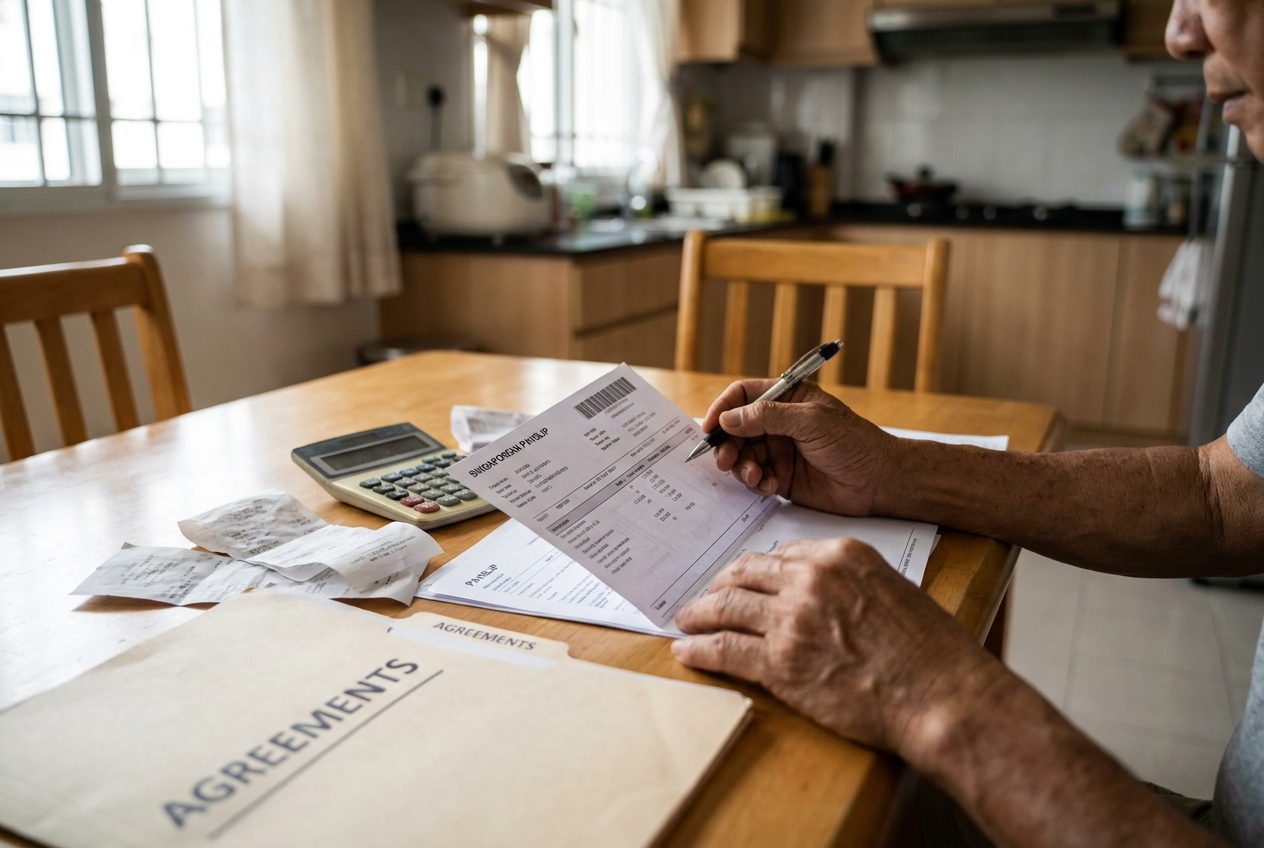
Understanding maid salary deductions in Singapore starts with one MOM principle: if you employ a migrant domestic worker (MDW), the Ministry of Manpower treats her basic salary as hers in full. Employers can only deduct in narrowly defined circumstances, and the rules are stricter than most households realise. This guide walks through what MOM allows, what is never deductible, and the documentation that keeps you compliant in 2026.
The General Rule: Her Salary Is Hers
Under the Work Permit conditions in Singapore's Employment of Foreign Manpower Act, an MDW's monthly basic salary belongs to her. Any deduction must satisfy three tests: it must be (a) authorised under MOM's rules and (b) agreed in writing with the helper. MDWs are excluded from the Employment Act, so the 25% deduction cap that applies to local employees does not apply here; MOM instead requires her declared salary to be paid in full. Make an unauthorised or unconsented deduction and it is unlawful, regardless of how reasonable it feels to you.
Before you compute deductions, you also need a clean baseline salary figure. If you're still working that out, see our guide on how to calculate helper salary in Singapore for 2026.
What MOM Specifically Allows

With the helper's prior written consent, MOM permits a short list of deductions:
- Mobile phone loan repayment. If you advanced money for a phone, you may recover it on terms she agreed to in writing.
- Personal cash loan repayment. If you lent her money (for a family emergency, a remittance gap, a medical bill back home), you may recover it on agreed terms.
- Income tax is the only other item that could in principle be deducted, but Singapore does not tax MDW salaries (see below). MOM does not allow deductions for damage to household items, even where the helper has admitted fault in writing.
- Income tax. Singapore does not tax MDW salaries, so this line is almost always not applicable.
Everything else, even costs that feel like they should be shared, is the employer's responsibility.
What Is Never Deductible

The following are employer obligations under MOM rules and cannot be passed back to the helper in any form:
- The FDW levy (S$300 standard, S$60 concessionary).
- The S$5,000 security bond and MDW insurance.
- Food and meals (see our food allowance guide) for what you must provide.
- The Settling-in Programme (SIP) fee.
- Medical examinations: PEME on arrival and the six-monthly medical (6ME).
- Her air ticket home at the end of contract.
- Uniforms or employer-required clothing.
- Cleaning supplies, detergents, household goods.
- Any agency loan disguised as an employer loan to recover placement fees.
The Agency Loan Trap
Many helpers arrive in Singapore owing six to eight months of salary to source-country agencies for POEA, BP2MI, or equivalent processing in the Philippines, Indonesia, or Myanmar. This is not your business as the Singapore employer. You pay her the full monthly salary stated in her In-Principle Approval (IPA); she remits to her overseas agency on her own.
Some Singapore agencies still propose salary deduction schemes where the employer holds back six months of pay and remits it to the source agency. MOM treats these arrangements with extreme suspicion, and any documentation that shortcuts the helper's right to receive her salary in full is a Work Permit condition breach. If an agency suggests this to you, walk away. Reviewing the criteria to hire a maid in Singapore before signing helps you spot these red flags early.
How Much Can Be Deducted
The 25% (and 50%) monthly deduction caps in the Employment Act apply to local employees covered by that Act, not to migrant domestic workers. MDWs are excluded from the Employment Act, so there is no MDW-specific percentage cap. What MOM requires is that her declared salary is paid in full, and that any agreed loan repayment is reasonable, spread over a sensible period, and never leaves her without her wages.
The practical guidance is the same: keep any repayment modest relative to her monthly salary, agree it in writing, and never stack deductions so heavily that she effectively goes unpaid in a given month.
Written Agreement Requirements
Before any deduction, prepare an itemized agreement and have the helper sign it. At minimum it must show:
- The amount loaned or owed, in Singapore dollars.
- The monthly repayment figure.
- The total number of months.
- The reason (phone advance, cash loan, agreed damages).
- The helper's signature and the date.
- Your signature as employer.
Keep the original in a folder; give her a photocopy. Verbal agreements are worthless if a dispute reaches MOM.
Pay Slip Itemization
Every deduction must appear as a separate line item on her monthly pay slip. You cannot show only the net figure. A compliant pay slip looks like this:
- Basic salary: S$650.00
- Less: Phone loan (month 3 of 6): -S$50.00
- Less: Cash loan (month 2 of 4): -S$50.00
- Net pay: S$550.00
She signs to acknowledge receipt. You keep a copy. Both parties should keep these for at least the duration of the contract plus one year.
Common Employer Pitfalls
Even well-intentioned employers slip into illegal practices. Watch for these:
- Deducting training cost from her salary. Whatever the agency charged you to train her is your sunk cost, not hers.
- Withholding one or two months' salary as a performance bond. Illegal. Her salary must be paid within seven days of the end of each salary period.
- Deducting for broken or damaged household items. MOM does not allow deductions for damage to household equipment, even with a written admission of fault.
- Charging her for an agency replacement. If the placement fails and the agency provides a replacement, the cost arrangement is between you and the agency.
If Illegal Deductions Happen
If a helper believes her employer is deducting unlawfully, she can:
- Call the MOM FDW Helpline (1800-339-5505).
- File for mediation with TADM (Tripartite Alliance for Dispute Management).
- Approach her embassy. The Philippine, Indonesian, and Myanmar embassies all run MDW assistance desks.
Typical outcomes include full restitution of the deducted amount, a formal warning to the employer, and in repeat or serious cases the revocation of the employer's privilege to hire an MDW. MOM keeps a record, and that record follows you to future Work Permit applications.
End-of-Contract Final Accounting
When the contract ends (whether by completion, early termination, or transfer), you must give the helper a written final accounting showing every deduction made during the employment period, the running balance of any loan, and any outstanding amount waived or paid down. If you collected a deposit or held back salary for any reason (which, again, you should not have done), it returns to her in this final settlement. Settle in cash or bank transfer with a signed receipt.
Bottom Line
The MOM framework is simple in spirit: her salary is hers, you bear the cost of employing her, and the few deductions that are allowed must be agreed in writing, kept reasonable, and recorded on the signed monthly salary record. Get those mechanics right and you avoid the most common Work Permit breach we see at Upwill.