Maid Food Allowance Singapore 2026: The S$300 Rule Explained
TL;DR: The maid food allowance in Singapore is not a salary deduction. MOM requires you to provide adequate food daily, or pay a cash food allowance sufficient for your helper to feed herself. Provide good meals and you have already met the rule.
Few topics confuse first-time employers more than the maid food allowance in Singapore. Some households assume they can simply deduct S$300 from the salary. Others believe they need not feed the helper at all if she cooks for the family. Both are wrong, and both can land an employer in front of the Ministry of Manpower (MOM). This 2026 guide walks through exactly what the law says, what source-country embassies enforce, and how to handle the awkward edge cases like dietary restrictions, halal kitchens, and cash-vs-meal arrangements.
1. What MOM Actually Requires in 2026
Under the Employment of Foreign Manpower Act and the standard Work Permit conditions, every employer of a Foreign Domestic Worker (FDW) must provide adequate food daily. MOM's published requirement is simply 'adequate food': it does not specify a number of meals per day. In practice many households treat around three meals a day with reasonable access to drinking water as a sensible norm, but that is a practical benchmark, not an MOM rule. If the employer chooses not to provide meals, they must instead pay a monthly cash food allowance sufficient for the helper to feed herself.
This is not optional, and it is not deductible from the basic salary. It is a separate employer obligation. The helper's wellbeing, nutrition included, is part of the upkeep and maintenance that the Work Permit binds you to.
2. The S$300 Baseline: Where the Number Comes From
There is no fixed statutory dollar figure for the food allowance. MOM and the source-country embassies require 'adequate food or a food allowance' rather than a set amount. The Philippine MWO Standard Employment Contract for Household Service Workers, for example, requires adequate food or a food allowance without naming a dollar figure. Treat any specific monthly number as a market norm, not an enforced minimum.
- Is there a fixed floor? No statutory dollar figure exists; the obligation is to provide adequate food or a sufficient allowance.
- How much do employers typically set? Many set more where there are specific needs. Many employers set S$350 to S$400 when the helper has specific dietary needs (halal-certified ingredients, lactose-free, vegetarian) or when the household is too far from affordable wet markets.
If you are still budgeting your overall hiring cost, our breakdown of how much it costs to hire a maid in Singapore 2026 folds food allowance into the full monthly picture.
3. In-Kind Meals vs Cash Allowance
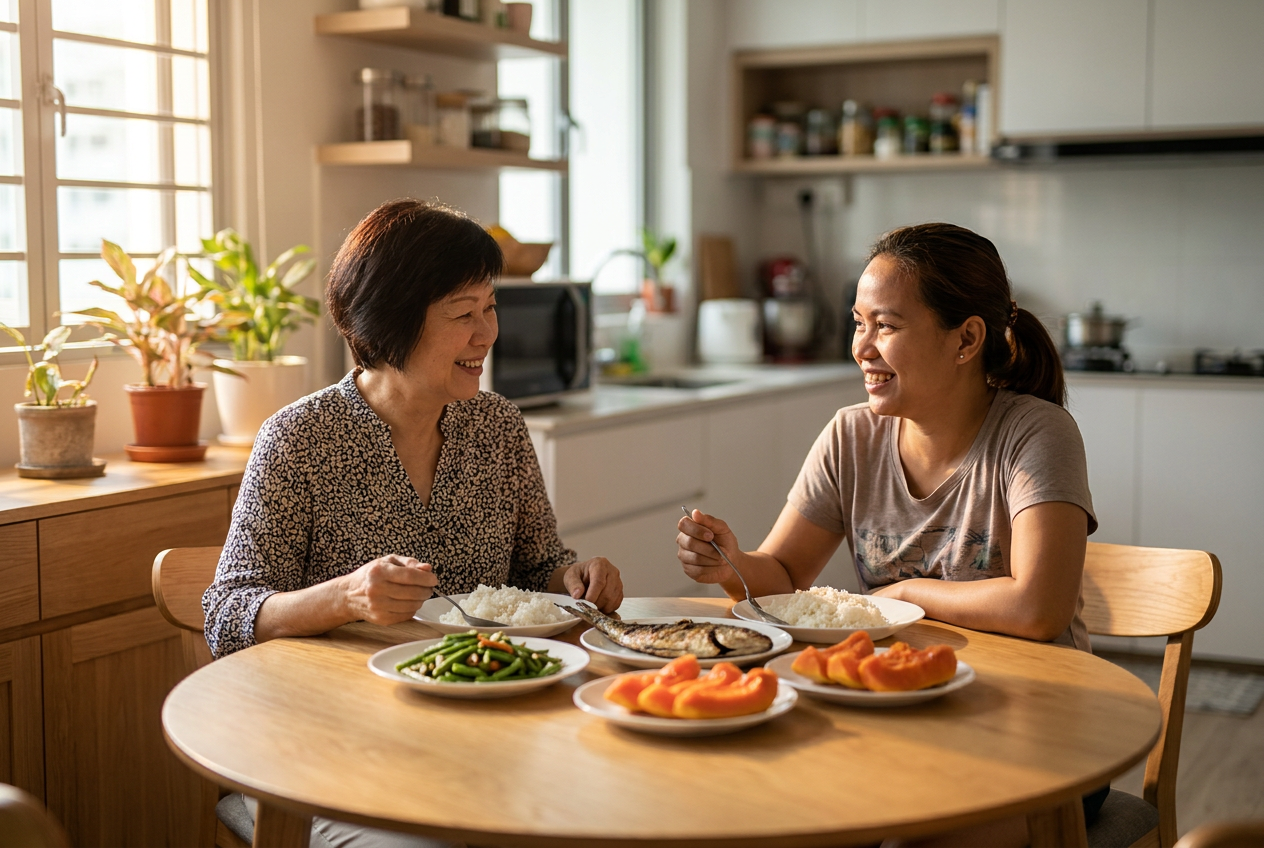
The vast majority of Singapore households satisfy the food requirement in-kind, the helper eats the same meals as the family, prepared at home. This is perfectly compliant and usually preferred by helpers themselves, because it gives them more disposable income.
A cash allowance is only triggered in two scenarios:
- The household genuinely cannot provide meals (e.g. employer travels constantly, helper is stationed at a separate property).
- The helper's dietary needs differ so significantly from the family's that she buys and prepares her own food (common with Muslim helpers in non-halal households, or strict vegetarians).

4. What Actually Counts as Providing Food
Employers often ask where the line sits. Here is the practical checklist:
- Same meals as the family, fully compliant, the gold standard.
- Adequate halal options for Muslim helpers, compliant, and culturally expected.
- Vegetarian options for Hindu or Buddhist helpers, compliant; common for Indian helpers.
- Helper cooks her own food from groceries you buy, acceptable only if the menu and quantity are mutually agreed and she has unrestricted access.
- Locking the fridge, rationing rice, restricting portions, a clear MOM violation and one of the fastest ways to be barred from hiring in future.
Food adequacy sits alongside other welfare baselines, see our notes on helper accommodation standards and the mandatory rest day rules for the full welfare picture.
5. The No-Pork-No-Beef Misconception
A recurring pitfall is the religious mismatch between employer and helper. A Chinese-Singaporean Buddhist household may not eat beef; a Muslim helper from Indonesia will not eat pork. Many employers wrongly assume the helper will simply eat around whatever is served. She will not, nor should she be expected to. Halal observance is not a preference; it is a religious obligation.
The protocol is simple: discuss dietary boundaries openly at the matching stage (well before deployment), and document the agreed approach in the contract. Mutual respect at the kitchen table prevents most food disputes from escalating to MOM.
6. Documenting Cash Allowance Correctly
If you do pay a cash food allowance, the documentation rules are strict:
- Record it separately on the monthly salary record you and the helper both sign, never blend it into basic salary.
- Do not call it a deduction. It is an employer payment, not a withholding.
- Pay it in full. Pro-rating for sick days or absence is not permitted.
- Reflect it in the employment contract. The In-Principle Approval (IPA) should match.
For the wider salary mechanics, see our companion guide on how to calculate helper salary in Singapore 2026.
7. Common Employer Mistakes
- Calling the food allowance a salary deduction, a red flag MOM watches for.
- Paying less than S$300/month cash with no meal provision at all.
- Counting one main meal per day as adequate, it is not. Several meals a day is the practical norm.
- Restricting access to drinking water, fruit, or basic snacks between meals.
- Telling the helper to eat leftovers only, humiliating and non-compliant if leftovers are inadequate.
- Assuming the food allowance offsets levy or insurance, it does not.

8. Halal-Specific Considerations for Muslim Helpers
The majority of Indonesian helpers, and a meaningful share of Filipino helpers from Mindanao, are Muslim. If your household is not halal, industry-norm accommodations include:
- Separate utensils, pots, and a designated cutting board, clearly labelled for her use.
- Halal-certified rice, oil, and proteins, available in every NTUC FairPrice and Sheng Siong.
- Avoid handling pork products during her active cooking shifts, or arrange a clean-down protocol.
- Respect Ramadan, allow her to take sahur before dawn and break fast at maghrib; do not demand cooking duties during iftar.
These accommodations are baseline professionalism, not a favour.
9. What Happens If a Helper Complains to MOM
If a helper files a complaint about inadequate food, most often through the FDW Helpline or her embassy, MOM typically follows this sequence:
- Initial fact-finding call with both parties.
- Mediation, often requiring a written meal plan or revised cash allowance addendum.
- Warning letter to the employer if breaches are confirmed.
- In serious or repeat cases: forfeiture of the S$5,000 security bond and a future hiring ban.
Genuine misunderstandings rarely escalate to the bond stage, but the warning sits on the employer's record and can affect future helper approvals.
10. Sample Contract Addendum
Below is a sample addendum employers can attach to the standard employment contract. Adapt to your household:
Food Provision Clause: The Employer agrees to provide the Helper with three (3) nutritious meals per day, including a protein source, vegetables, and a staple (rice or equivalent), along with reasonable access to drinking water, tea, coffee, and household snacks at all times. The Helper's dietary requirements are: [halal / vegetarian / no restrictions]. Where the Employer is unable to provide meals on any given day, a cash equivalent of not less than S$10 per day will be paid in addition to monthly salary, itemised separately on the pay slip.
Before you finalise an employer-helper match, double-check our checklist of criteria to hire a maid in Singapore 2026 to ensure dietary needs are part of the screening conversation.
The Upwill View
Most food disputes are avoidable. The employers who never see a complaint are the ones who treat the kitchen as shared territory, not a battleground: same rice cooker, same fruit bowl, same fridge access. The S$300 figure is a regulatory backstop, not a target. If you genuinely provide three good meals a day, you have already met the standard, and no embassy or MOM officer will ever question it.
Reviewed by Yvonne, Senior Placement Consultant at Upwill Employment Services (EA Licence 24C2628). Last reviewed: 31 May 2026.