Helper Room Ideas Singapore 2026: HDB Layouts, MOM Accommodation Rules, Design Tips
TL;DR: A MOM-compliant helper room in a Singapore HDB flat must protect her from sun and rain, have enough ventilation (a fan if natural airflow is poor), a mattress, pillow and blanket, a safe spot away from hazards and the toilet, and privacy: no male adult or teenager in the room and no camera where she sleeps or changes. MOM sets no minimum size, and SCDF caps a household shelter at 4.8 sqm, so plan the space carefully. Updated 22 September 2026.
A good helper room in Singapore has to do two jobs at once. It must satisfy MOM's accommodation requirements for migrant domestic workers, and it must be a place your helper actually wants to come home to after a long day. In many HDB flats that means working with a small utility room or the household shelter, but small does not have to mean grim.
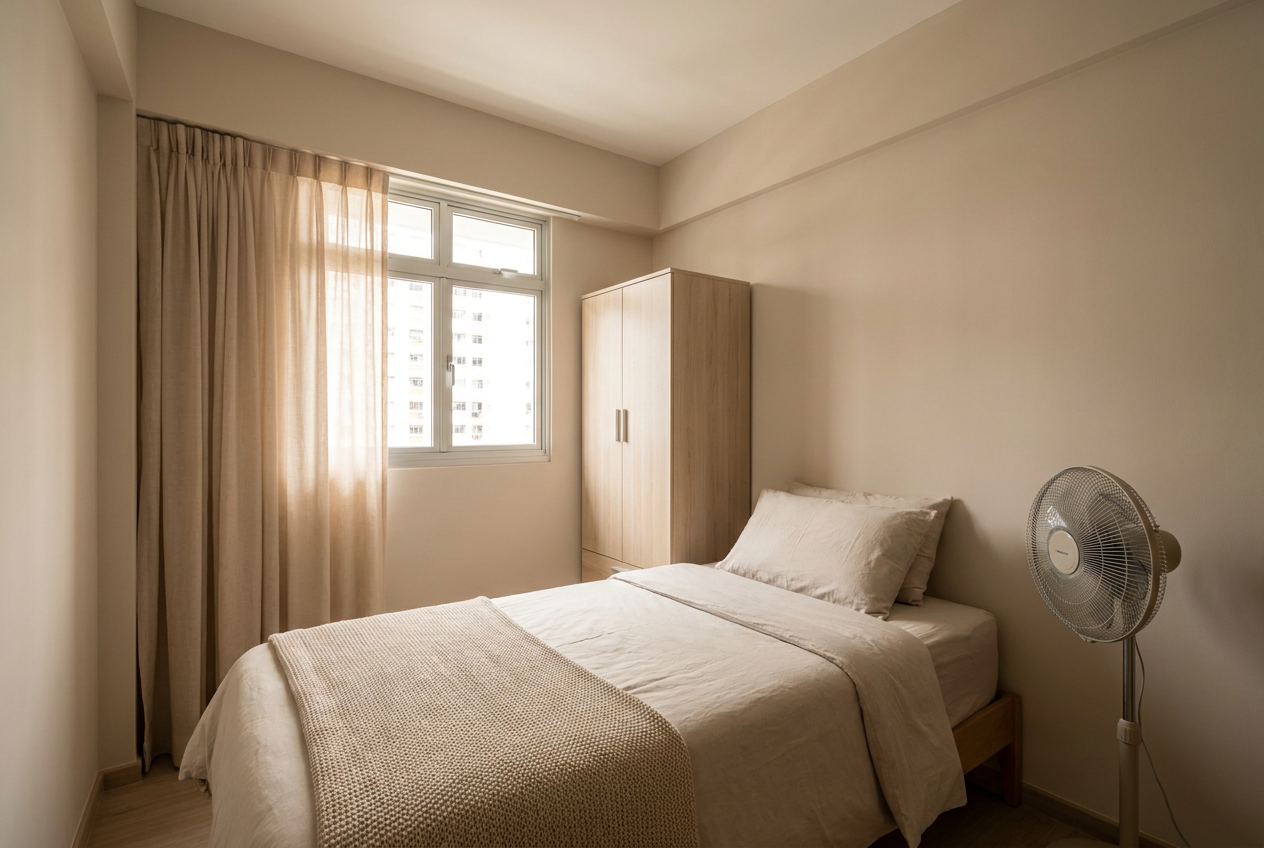
This guide walks through MOM's non-negotiables, what SCDF lets you do inside an HDB household shelter, a bedroom essentials checklist, and practical design ideas for ventilation, storage, privacy and personal touches. Whether you are setting up a room for a new helper arriving next month or refreshing an existing space, the goal is the same: legal, comfortable, dignified.
Reviewed by Yvonne, Placement Consultant at Upwill Employment Services (MOM EA Licence 24C2628).
MOM accommodation requirements: the non-negotiables
Before you think about paint colours or IKEA hacks, your helper's room has to meet the Ministry of Manpower's accommodation standards. MOM lists these as employer responsibilities on its rest days, health and well-being page, and they are repeated in MOM's guide to employing an MDW (PDF).
MOM's requirements for a migrant domestic worker's sleeping space are:
- Adequate shelter. The accommodation must protect her from sun, rain and strong winds. This is why open balconies, ledges and uncovered service yards are not acceptable as a helper's bedroom.
- Basic amenities. At minimum a mattress, pillow and blanket, plus bathroom amenities and toiletries. In practice, give her a proper single bed, not a sofa or a mat on the floor.
- Sufficient ventilation. If natural ventilation is inadequate, mechanical ventilation such as an electric fan must be provided.
- Safety and sanitation. She must not sleep near dangerous equipment or structures that could harm her, or near areas that are wet or pose sanitation problems, such as next to the toilet.
- Modesty. She must not sleep in the same room as a male adult or teenager. This rule alone rules out many "share with the son" arrangements.
- Space and privacy. MOM says you should provide a separate room. If that is not possible, you must make sure her sleeping area has adequate space and privacy (for example, a screened-off corner with a solid partition).
- Cameras. If you have video recording devices at home, you must tell her about them and where they are, and you must not install them where they compromise her privacy or modesty, such as where she sleeps, changes clothes, or the bathroom.
How big is an HDB helper room, really?
Most Singapore employers are working with an HDB flat, and the helper usually sleeps in one of three spaces: the household shelter (often called the bomb shelter), a utility or store room, or a spare bedroom. Room sizes vary by flat type and block generation, so measure yours rather than relying on a rule of thumb.
The household shelter is the one space whose size is set by regulation. SCDF's technical requirements for household shelters set a minimum internal floor area based on the flat's gross floor area, and cap every shelter at 4.8 sqm:
| Flat gross floor area | Minimum shelter floor area |
|---|---|
| 40 sqm or less | 1.44 sqm |
| Above 40 to 45 sqm | 1.6 sqm |
| Above 45 to 75 sqm | 2.2 sqm |
| Above 75 to 140 sqm | 2.8 sqm |
| Above 140 sqm | 3.4 sqm |
SCDF also sets a minimum internal width of 1.2 m and a clear height of at least 2.4 m. In plain terms: a shelter is narrow, and a standard single bed will take up most of the floor. That is why vertical storage matters so much in these rooms.
MOM does not publish a minimum square-metre rule, so "adequate space" is judged on whether a bed, storage for her things and room to move all fit, with ventilation and privacy preserved. A small room with good airflow, a fan and tidy storage is far better than a bigger space that is hot, cluttered or shared with household equipment.
Setting up the room before your helper arrives? Upwill (MOM EA Licence 24C2628) walks every employer through the MOM accommodation requirements as part of placement, so the setup passes without guesswork. Chat with us on WhatsApp or see our maid placement service.
Using the household shelter as her room: what SCDF allows
Many HDB families use the household shelter as the helper's room. That is fine for MOM as long as the accommodation rules above are met, but the shelter itself is protected by SCDF rules. From SCDF's list of permitted and not permitted works for household shelters (PDF):
- You may paint the walls, ceiling and door (but not over the door notice, locking bolts or door seal), and lay vinyl flooring.
- You may drill into the inside walls and ceiling to a depth of no more than 50 mm to fix inserts and removable screws for shelves, cabinets or pictures. SCDF can ask you to remove these fixtures within 48 hours.
- You may cover the ventilation openings with a removable finish, as long as at least 25% of the total area of the two openings stays uncovered for airflow.
- You may not hack or drill the shelter walls, floor or ceiling beyond that, use power-driven nails on the inside walls, tile the inside walls, or modify the shelter door, frame or ventilation sleeves.
The practical takeaway: freestanding furniture, removable fixings and a good fan are the way to make a shelter liveable.
Bedroom essentials checklist
Before your helper arrives, the room should already contain:
- Single bed with a proper mattress, not a foldable mattress on the floor, not a camp bed.
- Fitted bedsheet, pillow, pillowcase, and a light blanket.
- Wardrobe or hanging rack with shelves for her clothes, ideally with a section she can lock or keep private.
- A working light, overhead and ideally a small bedside or task light.
- An electric fan (wall-mounted or standing). MOM requires mechanical ventilation where natural airflow is inadequate; air-con is a bonus.
- A power point for fan, phone charger and a small task light.
- A door that closes, or a solid partition that gives genuine privacy.
- A small mirror and a hook or two for towels and bags.
Optional but appreciated: a small shelf or basket for personal items, a prayer mat or religious-item storage, and a chair if there is floor space for one.
Ventilation and lighting
Heat and stale air are the most common helper-room problems in HDB flats, and the easiest to fix. Ventilation is a MOM requirement; good lighting is simply good practice.
For ventilation:
- If the room has a window, keep it openable. Do not seal it shut with boxes stacked against it.
- If the only "window" is into the kitchen or service yard, add a fan so air actually moves through the room.
- For household shelters, which have no window, a wall-mounted or standing fan is the practical minimum. Do not block the shelter's ventilation openings: SCDF requires at least 25% of their area to stay uncovered.
- Avoid using the helper room to dry laundry: humid laundry in a small unventilated room is uncomfortable and a mould risk.
For lighting:
- A warm-white overhead light feels softer than the harsh cool-white tubes often pre-installed in utility rooms.
- Add a small bedside or clip-on light so she can read or use her phone without lighting up the whole room.
- If the room has no window, a mirror opposite the door bounces light and makes the space feel less boxy.
Storage solutions for compact rooms
In a small room, storage is the difference between liveable and cluttered. A few ideas that work in HDB helper rooms:
- Vertical, not horizontal. A tall narrow wardrobe beats a short wide one, and a household shelter gives you at least 2.4 m of clear height to use.
- Under-bed storage. Choose a bed frame with built-in drawers, or use shallow plastic boxes under a standard frame for seasonal items and her luggage.
- Over-door hooks and pockets for accessories, scarves, bags and laundry, with no drilling at all.
- A single shelf above the bed for a few books, photos and a small clock. In a shelter, fix it with removable screws within SCDF's 50 mm drilling limit.
- One "personal" lockable drawer for documents, savings, religious items and small valuables. This signals trust and reduces friction.
Resist the temptation to use her room as the household's overflow storage. Boxes of old toys, broken appliances and seasonal decorations stacked in the helper room is a common and easily avoidable point of conflict, and heavy items stored above her bed can breach MOM's rule against sleeping near structures that could harm her.
Privacy considerations
Privacy is not optional, it is part of MOM's accommodation rules. Aim for these:
- A door that closes from inside, or a solid partition or heavy curtain if the room has no door.
- If she sleeps in a shared room (for example with a young child, or in a partitioned area), make sure the partition is genuine: a real curtain, a folding screen, or a half-wall, not a notional line on the floor.
- Never share with a male adult or teenager. If the only spare bed is in your teenage son's room, that arrangement is not allowed under MOM rules.
- No cameras inside the room. Tell her where any cameras in the home are, and keep her sleeping and changing areas and the bathroom off-limits.
- Knock before entering. Small habit, big difference.
Helper room design ideas (paint, lighting, multifunction)
Within the MOM and SCDF rules, there is plenty of room to make a small space feel calm and personal.
Paint and finish
- Stick to light, warm neutrals: off-white, soft beige, pale grey. Dark walls make small rooms feel smaller.
- One feature wall in a muted sage, dusty blue or warm terracotta can lift the space without overwhelming it. Painting is allowed inside a household shelter.
- Use washable paint near the bed and door so marks wipe off easily.
Lighting layers
- One ambient overhead light, one task light and one warm bedside light is the classic small-bedroom recipe.
- A dimmable bulb changes the whole feel of a small room in the evening.
Multi-functional furniture
- Storage bed frame: sleep on top, store luggage and off-season clothes below.
- A slim fold-down desk doubles as a vanity and a corner for video calls home. In a shelter, choose a freestanding one.
- A narrow bedside table with two shelves replaces a separate side table and bookshelf.
Soft touches
- One framed print, one small plant (artificial if there is no daylight), one rug. That is usually enough.
- Let her personalise the space: photos from home, a small religious item, a poster. The room is hers for as long as she lives in your home.
Cultural and religious accommodation (prayer corner, halal storage)
Helpers from Indonesia, the Philippines and Myanmar come from a range of faiths, and religion is often a meaningful part of daily life. MOM's employer guide also asks you to bear in mind possible differences in diet due to her cultural or religious background. A few small accommodations cost nothing and matter a lot:
- Muslim helpers typically pray five times a day. A clean corner with space for a prayer mat and a hook for a prayer garment is enough.
- Halal storage: if your helper is Muslim, give her a dedicated drawer, cupboard or shelf for her own food, utensils or cooking items that she would like to keep separate from non-halal household food. A clearly labelled basket inside the shared fridge works well.
- Christian helpers often appreciate space for a small Bible, rosary or icon, and a single shelf or hook is plenty.
- Buddhist helpers may keep a small altar item or amulet: again, a private shelf and respectful placement is all that is needed.
You do not need to share her religion to respect it. Asking her once, when she arrives, what would help her practise her faith comfortably is one of the easiest trust-builders in the first month.
Common accommodation mistakes to avoid
Each of these breaks at least one of MOM's accommodation requirements. Avoid all of them.
- Sleeping on the living-room sofa with no privacy and household members walking through at all hours.
- Sleeping in the kitchen next to the stove, gas pipe or water heater (dangerous equipment).
- Sleeping on an open balcony or in a service yard exposed to rain, sun or wind.
- Sleeping next to the toilet or in a wet area.
- Sleeping in a closed household shelter with no fan and no airflow. The shelter can be a bedroom, but it needs ventilation, a proper bed and bedding.
- Sleeping on the storeroom floor with cleaning chemicals and heavy equipment stored above her.
- Sharing a room with a male teenager or adult.
- A camera inside the room or pointed at the bed or changing area.
- Room used for drying laundry at the same time as a bedroom, leaving her bedding constantly damp.
If you have inherited a setup like any of the above, fix it before your helper arrives.
Helper room setup checklist
Run through this list before your helper's first night:
- Single bed with mattress, sheet, pillow, pillowcase and a blanket.
- Bathroom amenities and toiletries ready for her.
- Wardrobe or hanging rack with at least one lockable drawer or section.
- A door that closes, or a partition that gives real privacy.
- Working overhead light plus a bedside or task light.
- Electric fan (wall, standing or ceiling).
- At least one power point within reach of the bed.
- Window open and clear, or a fan if there is no external window. Shelter ventilation openings at least 25% uncovered.
- No cameras in the room, bathroom or changing area, and she has been told where any other cameras are.
- No dangerous equipment, gas cylinders or chemicals inside the room, and not beside the toilet.
- Space for a prayer mat or small religious item if relevant.
- A clean, empty drawer or shelf that is hers, not the family's overflow.
Set the room up before she moves in, not after. It signals, without any speech, that she is welcome, expected, and treated as a member of the household rather than an afterthought.
For wider context, see our guides on helper first month settling-in, helper salary benchmarks, nationality comparison, and what to do if your helper wants to terminate her contract. The full MOM accommodation rule summary lives on our accommodation requirements page.
Reviewed by Yvonne
Yvonne is a placement consultant at Upwill Employment Services (MOM EA Licence 24C2628), advising Singapore families on helper hiring, room set-up and MOM compliance. Last reviewed 22 September 2026 against MOM's accommodation requirements and SCDF's household shelter rules.