How to Terminate Maid Contract Singapore 2026: Legal Process, Notice & Cancel Work Permit Guide
TL;DR: To terminate a maid contract in Singapore, serve the notice stated in your contract or pay salary in lieu, agree her last working day, then cancel her Work Permit in MOM's FDW eService within 1 week of that day. Settle all salary, pay for her flight home (including check-in luggage) so she leaves within 2 weeks of the cancellation, and your $5,000 security bond is usually discharged about a week after she departs.
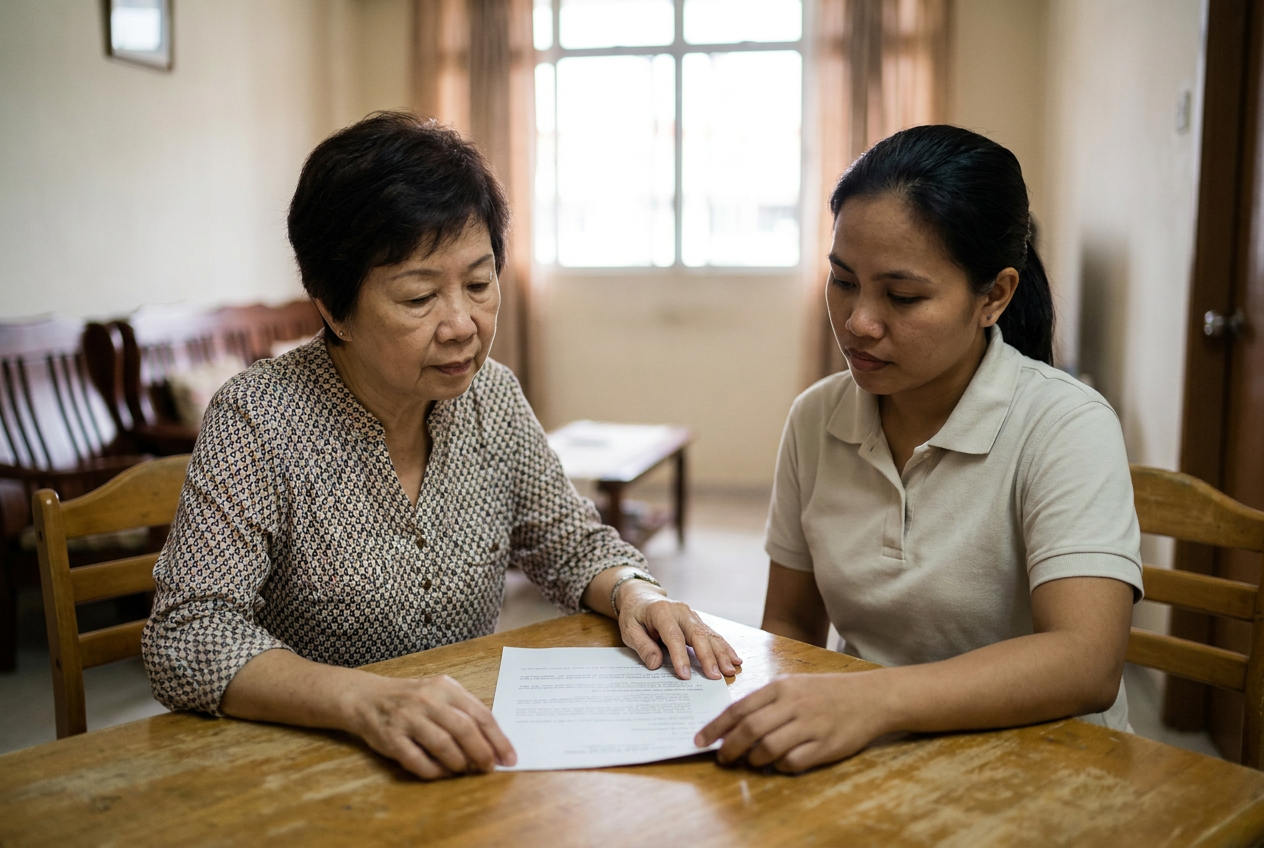
Ending a helper's employment is one of the harder decisions a Singapore employer will face. Sometimes the match simply isn't working; sometimes there's a serious issue; sometimes life circumstances change. Whatever the reason, the Ministry of Manpower (MOM) sets out what you must do, and getting it wrong can mean a forfeited $5,000 security bond, an overstaying fine, or unnecessary distress for both of you.
This 2026 guide walks you through notice, the step-by-step process, what you must pay, what happens to the bond, and what your agency does for you. Last reviewed against MOM sources on 22 September 2026.
Can I end my helper's contract, and on what grounds?
Yes. Either you or your helper can end the employment. MOM's guidance is straightforward: serve the notice stated in your contract, or make a payment in lieu of notice. Usually, the party who wants to end the contract is the one who compensates. See MOM's guide on ending your helper's employment.
The common situations employers face:
- Mutual agreement. Both sides accept the arrangement isn't working and agree a last day. This is the calmest path for everyone.
- Serious misconduct. For example theft, or harm to a child or elderly person in her care. Document it, and report crimes to the police. Your contract's notice terms still matter, so talk to your agency before acting.
- Medical results. If she is found to be pregnant at her six-monthly medical examination, the clinic updates MOM. If it is found at any other time, you must update MOM and upload a copy of the doctor's memo. MOM will contact you within 7 working days after it receives the medical results (MOM: notify MOM of changes).
What you must not do
Some actions breach MOM rules whatever the reason for ending the employment:
- Withholding salary. Salary must be paid no later than 7 days after the end of each salary period, including her final period.
- Keeping her passport. MOM says employers should not keep their helper's passport or force her to hand it over, and she must have unrestricted access to it.
- Letting her keep working after cancellation. Once the Work Permit is cancelled, it is an offence for her to work, even while she waits for her flight.
- Making her pay her own way home. Repatriation is the employer's cost.
- Leaving her without a valid pass. If she stays in Singapore beyond what her pass allows, an overstaying fine may be imposed.
If you're unsure how to handle your situation, speak to your agency before issuing notice.
Notice period in 2026
The notice required is whatever your signed employment contract says. Check it before you have the conversation. If you want her to stop working straight away, pay her salary in lieu of the notice period instead.

The 5-step termination process
- Document the reason. Keep dated notes, written warnings and any evidence. For crimes, make a police report.
- Talk to your helper and agree her last working day. MOM asks employers to reach agreement with the helper on her final work day before cancelling the permit. Give her the notice in writing and keep a signed copy.
- Notify your maid agency. A good agency will try mediation if the issue is fixable, or handle departure logistics if not.
- Cancel the Work Permit within 1 week. Log in to MOM's FDW eService (you, your sponsor or your agency can do this) and submit the cancellation within 1 week after her last day of work. The cancellation takes effect immediately, and the levy is charged until 1 day before the cancellation. Full instructions are in our Cancel Maid Work Permit Singapore 2026 guide and on MOM's cancellation page.
- Settle final pay and send her home within 2 weeks. Buy her air ticket with check-in luggage, and cover connecting transport to the international port nearest her hometown. Her departure must be within 2 weeks of the cancellation. After the cancellation, print the Special Pass and give it to her; it allows her to stay in Singapore until she leaves. She can be repatriated to a destination other than her home country only if you both agree, and you must tell MOM when you cancel.
Notice pay vs payment in lieu
Two options exist once you've issued notice:
- She works the notice period. She continues her duties through the last working day and is paid normally.
- Payment in lieu of notice. You pay her the equivalent salary for the notice period and she stops working. This is common where trust has broken down or the household includes vulnerable persons.
Whichever you choose, the amount should match what your contract provides for the notice window.
Final settlement: what you owe her
On her last day, settle in writing and have her sign a record. Components include:
- Outstanding salary for the current period, up to the last working day.
- Compensation for any rest days she agreed to work and was not paid for: at least one day's salary each, which MOM calculates as monthly salary divided by 26 (MOM).
- Notice pay, if you opted for payment in lieu.
- Any of her money you are holding. MOM says you must not keep her salary or money, even if she asks.
- Her passport, phone and belongings, which are hers.
Items you do not deduct: the levy, insurance, the security bond, or her repatriation costs.
What your agency does
A licensed Singapore agency like Upwill (EA Licence 24C2628) typically handles:
- Cancelling the Work Permit in the FDW eService on your behalf.
- Booking the return flight to her home country.
- Printing her Special Pass, which lets her stay in Singapore until she leaves.
- Mediating any wage or property dispute before it escalates to MOM.
- Tracking the security bond discharge after she leaves.
- Starting the search for your next helper.
If the helper is the one initiating the end of the contract, read our companion guide: What to do when your maid wants to terminate the contract.
The $5,000 security bond
Every employer buys a $5,000 security bond for each non-Malaysian helper. MOM says it is usually discharged about one week after your helper has left Singapore, once the permit is cancelled, she has returned home and no conditions were breached (MOM security bond). The bond can be forfeited if:
- You or your helper breach any Work Permit or security bond condition.
- You don't pay her salary on time.
- You fail to send her home when her Work Permit is expired, revoked or cancelled.
- She goes missing.
For breaches by the helper, MOM may not hold you liable if you can show you informed her of the conditions and reported the breach promptly. If she goes missing, make a police report and cancel her Work Permit within 1 week of finding out. Full bond mechanics are explained in Security Bond for FDW Singapore 2026.
If she wants to work for another employer
A helper can move directly to a new employer instead of going home, but only with your consent. The new employer submits the request through the FDW eService, you approve it, and the new permit must be issued within the timelines MOM sets; her current permit is cancelled automatically when the new one is issued (MOM: transfer to a new employer). The details are in How to Transfer Helper Singapore 2026. If there is no agreed new employer, cancellation and repatriation is the standard path.
If she refuses to leave
Rare, but it happens, usually when she fears returning home or believes there's an unresolved wage issue. Steps:
- Record what happened in writing, dated.
- Contact your agency. They can speak with her in her own language and find the real concern.
- Settle any genuine outstanding amount immediately to remove the reason for refusal.
- Call MOM on 6438 5122 for guidance. She can also call MOM's MDW Helpline on 1800 339 5505 if she has a salary claim.
Remember that after cancellation she needs a Special Pass to stay lawfully, and you remain responsible for sending her home.
Planning your next helper
Before you hire again, check one rule that catches employers out: if your next helper will be your 4th or more within a 12-month period, MOM requires you to attend the CONNECT Workshop run by the Association of Employment Agencies (Singapore), which costs $80, and will not process your application until you attend (MOM FAQ, PDF). Browse the criteria for hiring a maid in 2026 while the lessons are still fresh.

Send her off with dignity
Even when termination is for cause, how you handle the last week matters. She is leaving a livelihood that supports her family. Pay her in full, make sure she has her passport and phone, give her time to pack, and offer an honest reference if you can. If the situation allows, a short conversation acknowledging what worked between you is a kindness she will remember. For helpers leaving on good terms who simply need time at home, the home leave guide explains home leave as an alternative to ending the contract.
Termination done well, documented, fair, and dignified, protects your bond, your conscience, and the broader system that helpers and Singapore households depend on.