Helper Passport Rules Singapore 2026: Who Holds It, MOM Rules & Penalties
TL;DR: Under Singapore law, your helper passport is her personal property. MOM and the EFMA forbid an employer or agency from holding or withholding it. Penalties reach a S$10,000 fine and 12 months jail, and offenders may also be barred from hiring a foreign domestic worker.
Last reviewed: 20 May 2026 by Yvonne, Senior Placement Consultant, Upwill (EA Licence 24C2628).
Every month, Upwill fields the same question from new employers: should I hold my helper's passport for safekeeping? The instinct is understandable. A lost passport is expensive and disruptive, but the answer under Singapore law is unambiguous. The passport belongs to your foreign domestic worker (FDW), full stop. Confiscating or refusing to return it is one of the most prosecuted Work Permit condition breaches in Singapore, and the consequences are severe.
This guide explains exactly what the Ministry of Manpower (MOM) and the Employment of Foreign Manpower Act (EFMA) require, the penalties for getting it wrong, and the practical workarounds that keep both you and your helper safe.
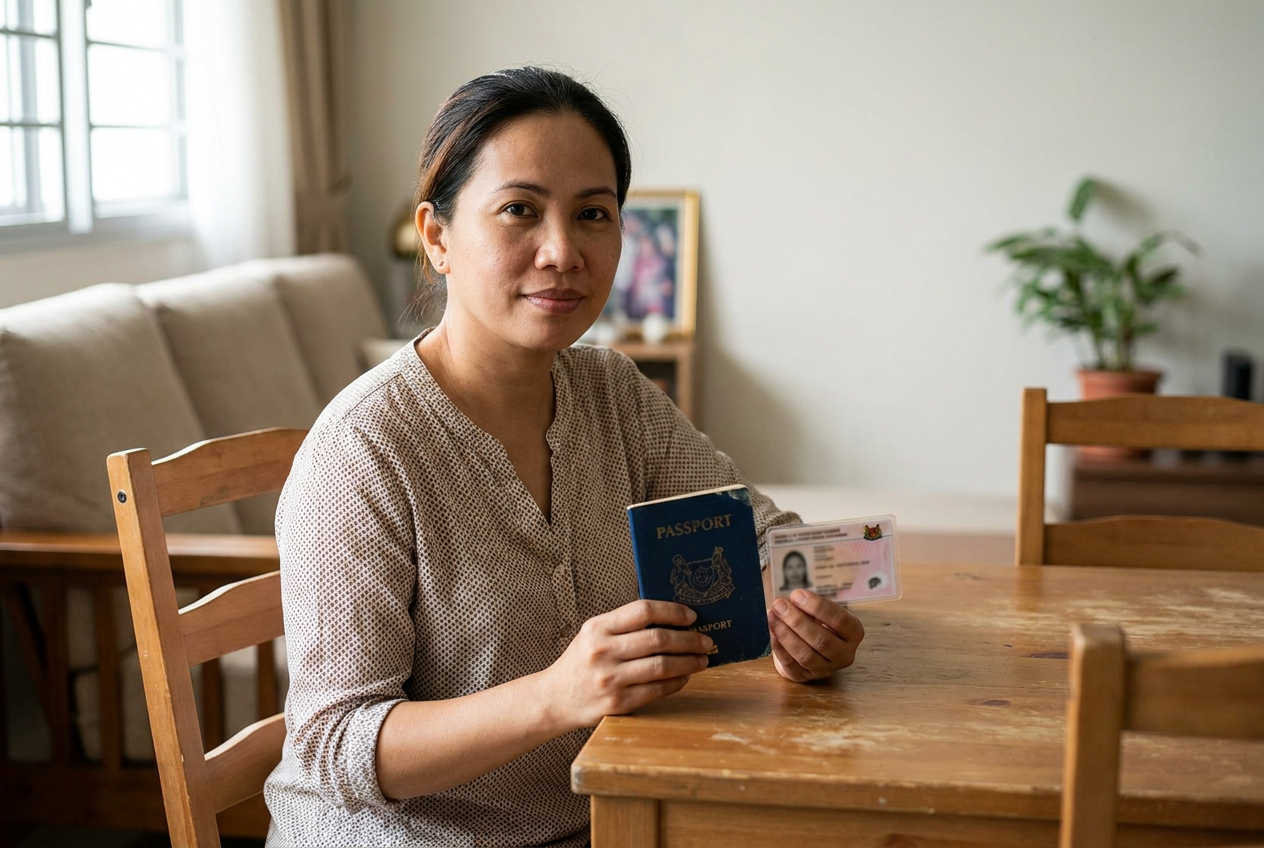
1. The Law Is Unambiguous: The Passport Always Belongs to Her
Under MOM's Work Permit conditions and the EFMA, a foreign domestic worker's passport is her personal property. An employer or employment agency has no legal right to confiscate, withhold, or refuse to return it, not even temporarily, not even for her own good.
This is not a grey area. MOM prosecutes multiple cases every year, and convictions are routinely reported in the news with the employer named publicly. The rule applies from the moment your helper lands at Changi until the day she leaves Singapore on cancellation.
2. Why Employers Do It Anyway (and Why Every Reason Is Wrong)
The three reasons we hear most often:
- She might run away with our valuables. Holding her passport does not prevent absconding. She can still leave the house. It only adds a criminal charge to your file.
- She'll lose it. Helpers are adults responsible for their own documents in every other country they work in. Singapore is no different.
- The agency told us to. If an agency told you this, that agency is breaking the law and you should report them. No MOM-licensed agency (including Upwill) will ever instruct you to confiscate a passport.
None of these justifications hold up in court. The EFMA does not recognise good intentions as a defence.
3. The Work Permit Card Follows the Same Rule
The same principle applies to her Work Permit card. It is her identification document in Singapore, and she has the right to carry it on her at all times, alongside her passport. MOM officers, ICA, and police can ask her to produce both during random checks, and she needs them with her.
Many employers we meet are surprised to learn this. If she goes out on her rest day, she should have both documents on her person. See our rest day rules guide for related obligations.
4. MOM Rule History and Enforcement
The passport-retention prohibition is not new, but enforcement tightened substantially after the EFMA amendments in 2019-2020. Today, MOM works alongside NGOs: HOME (Humanitarian Organisation for Migration Economics) and FAST (Foreign Domestic Worker Association for Social Support and Training), both of which actively investigate complaints from helpers and refer cases to MOM.
When a helper reports passport withholding to MOM's FDW helpline (1800-339-5505), MOM investigates the complaint and may conduct checks.

5. Penalties for Passport Withholding
The penalties under EFMA are serious and stack together:
- Fine of up to S$10,000 per offence.
- Imprisonment of up to 12 months, or both fine and jail.
- Possible debarment from hiring a foreign domestic worker in Singapore, at MOM's discretion.
- Possible forfeiture of the S$5,000 security bond you posted when hiring.
- Public naming in MOM enforcement press releases, which are picked up by Straits Times, Channel News Asia, and Mothership.
The reputational damage often hurts more than the fine. Convicted employers' names appear in Google search results indefinitely.
6. The Safekeeping Arrangement: Risky Territory
Be careful with the idea of a 'safekeeping arrangement'. MOM's guidance is clear: employers should not keep their workers' passports, should not force a worker to hand over her passport, and the worker must have unrestricted access to it at all times. MOM does not state that an employer holding the passport with the worker's consent is acceptable. At most, the worker may choose to store her own passport securely, for example in a locker that she controls. We strongly recommend skipping any employer-held arrangement entirely. Let her keep her own passport from day one.
7. What Employers Should Do Instead
If she or you are genuinely worried about loss, there are three lawful options:
- Bank safe deposit box. Help her open a bank account (most do during the first month) and ask if the bank offers a small safe deposit box. The passport stays in her name, in her box.
- Locked drawer with her key. Provide a small lockable drawer or box in her room. She holds the only key. You do not have access.
- Photocopy for your records. Take a clear, dated photocopy of the bio page and Work Permit for your own files. This is fully legal and useful if she ever loses the original.

8. The 24-Hour Rule for Returning the Passport
If, for any reason, you are currently holding your helper's passport (under a safekeeping arrangement or otherwise) and she asks for it back, you must return it immediately. There is no 24-hour grace period in the wording of the law; immediately means at the moment of the request.
Refusing, delaying, or asking her to wait until tomorrow is the single most common trigger for an MOM investigation. If she calls the FDW helpline that evening, expect a call from a MOM officer the next morning.
9. Medicals, 6ME, and Immigration Appointments
Your helper carries her own passport to her six-monthly medical examination (6ME), Settling-in Programme, embassy appointments, and any ICA matters. You do not take it from her afterwards. She walks in with it, she walks out with it, and it stays with her.
If you accompany her to an appointment, you may carry supporting documents (medical referrals, employer letters) but not her passport.
10. What If She Runs Away?
Passport-holding is not a deterrent to absconding. A helper who genuinely wants to leave can walk out the door at any time, with or without her passport. She can report it lost at her embassy and obtain emergency travel documents within days.
The real deterrent is a good working relationship. Practical steps that actually work:
- Save your phone number, the agency hotline, and 999 in her phone on day one.
- Hold a 15-minute welfare check-in every two weeks. Ask about food, sleep, family back home, and work pace.
- Address grievances early. Most runaways follow weeks of unresolved small complaints.
- If the match is not working, handle the termination lawfully rather than letting the situation deteriorate.
11. Cultural Sensitivity
Many helpers come from rural communities where elders, husbands, or village heads traditionally hold important documents for safety. Your new helper may even offer her passport to you on her first day, expecting you to take it. This is not informed consent. It is cultural habit.
The right response is to explain, gently, that Singapore law works differently. Her passport stays with her. Show her where to store it safely. This conversation, done well, sets the tone for an honest working relationship.
12. Bottom Line for Singapore Employers in 2026
The rule is simple: her passport, her Work Permit, her property. Always. The fine is up to S$10,000 and the jail term is up to 12 months, and you may be barred from hiring a helper. There is no upside to holding her documents and every reason not to.
If you are hiring for the first time, review our hiring criteria guide and our Work Permit cancellation guide so you understand both ends of the employment lifecycle. Upwill (EA Licence 24C2628) walks every new employer through these compliance basics before placement.